28May

“Nur Barzahlung”

Warsaw, 9 AM. I Pay for My Coffee with BLIK... | Smart People Blog

Warsaw, 9 AM. I pay for my coffee with BLIK — I don't even take out my wallet. Two days later, Berlin. A sign on the café door: "Nur Barzahlung"...

... and suddenly I realise I'm no longer in the same world.

If you do business in Germany, that sign on the door tells you more about your clients than most market analyses. When we started expanding into the German market, one of the first things that surprised me wasn't the bureaucracy, the Betriebsrat, or the language of contracts.

As a Pole — used to BLIK, phone payments, contactless watches, and terminals literally everywhere — my first reaction was simple: How is this possible in 2026, in the fourth-largest economy in the world?

Then I started talking to clients. And very quickly I understood something important. This isn't backwardness. It's a deliberate choice. And the same mindset shows up at every negotiation table.

Numbers Worth Knowing

Cash in Germany — Deutsche Bundesbank data

Cash accounted for roughly half of all transactions in Germany in 2023 — with a clear decline compared to 2021. The direction is obvious: digital payments are growing, especially among younger Germans.

But decline doesn't mean rejection. Cash remains the most commonly used payment method in everyday transactions. "Nur Barzahlung" signs in cafés in Berlin or Munich are not a nostalgic relic — they are still normal.

And the debate about cash is very much alive. Politicians, consumer organisations and economists regularly discuss how long and in what form cash should remain in circulation.

Germany is not a country that cannot digitise. It's a country that refuses to do it blindly.

Not a Habit. A Value.

"Nur Bares ist Wahres" — only cash is real

The first time I heard this saying I treated it as a curiosity. Today I see it differently. It's shorthand for an entire way of thinking.

Datenschutz — data protection — in Germany is not a paragraph in a privacy policy. It's a value people grow up with. Cash leaves no digital trace. Nobody knows what you bought, where, or how much you spent. In a country that remembers very well where mass surveillance can lead, this isn't paranoia. It's historical memory.

There is also something that fintech presentations rarely mention: control. A banknote in your wallet is real. You see what you have. You see what you spend. No screen or app quite replaces that feedback.

And finally — a healthy distrust of systems that "work until they don't". Whenever proposals to limit cash appear in Germany, the reaction is immediate. Public, loud, and political. This isn't habit. It's a position.

You can disagree with it. But you can't ignore the logic behind it. Even if the direction of change is clear — Germans want to decide the pace themselves.

The View from the Other Side — Where We Come From

Poland — a different timeline

To be clear — I'm not saying Poland is worse or better. We're simply somewhere else on the timeline.

In Poland, the share of cashless transactions already reaches roughly two-thirds of all payments (NBP and Fundacja Polska Bezgotówkowa data).

BLIK — the Polish mobile payment system — processed 2.9 billion transactions in 2025 and has more than 20 million active users (BLIK operator data).

As a Pole, I can pay for coffee, send money to a friend, pay for parking, and order food with my phone. No wallet. No card. No cash. That's simply normal.

Which is exactly why a "Nur Barzahlung" sign on a café door in Berlin still catches many Poles off guard. But that moment of surprise is actually useful — if you turn it into understanding quickly.

Because the difference between Poland and Germany isn't about one society being more modern than the other. It's about different experiences shaping different instincts. Poland and Germany simply took different paths. The numbers show the difference. The reasons behind it are much deeper.

What Does This Have to Do with Business in the DACH Market?

Everything.

The attitude towards cash isn't just a cultural curiosity. It's a window into the value system behind German business decisions.

Four things I now expect at every DACH negotiation table

Caution. Germans rarely buy the first offer they see. They compare, analyse, and ask questions about details you might never even consider. Just as they don't blindly trust a payment app — they don't blindly trust a provider promising quick results.

Privacy and control. When the conversation turns to outsourcing consultants, access to HR systems, or employee data — the person across the table is someone for whom control over data and processes is not a preference. It's a condition.

Predictability. Cash always works. No internet, no servers, no updates required. German clients expect the same reliability from a business partner.

Long-term thinking. Germans haven't abandoned cash partly because they dislike decisions that can't easily be reversed. Choosing providers follows the same logic. They take longer to verify — but once they decide, they tend to stay.

I hear this regularly in conversations with DACH clients. Questions like: "What happens when your consultant leaves the project?" "Where does the knowledge stay?" "What guarantee of continuity do we have?"

This isn't a lack of trust. It's the same instinct that makes them keep banknotes in their wallet. They want to know they remain in control.

And if you understand why a German pays cash for coffee, you also understand why the same German may spend an extra month analysing your offer — and then stay with you for five years.

Culture shock isn't an obstacle. It's an advantage — if you understand it. Anyone doing business abroad eventually has the moment of thinking: why do they do it differently? The worst reaction is to dismiss it. The better reaction is to understand it — and adapt the way you talk, present your offer, and build relationships.

Germany doesn't move slower. Germany simply refuses to move blindly.

Cash in Germany isn't a problem to solve. It's a signal worth understanding.

Let's Talk

If you're going through your own "culture shock" in the DACH market — I'm always curious to compare notes.

It's a conversation, not a pitch.

Write to Me

28May

Fachkräftemangel. Or: How German HR Managers Are Learning to Live with a Problem They Can’t Solve.

Fachkräftemangel. Or: How German HR Managers Are Learning to Live with a Problem They Can't Solve | Smart People Blog

Fachkräftemangel. Or: How German HR Managers Are Learning to Live with a Problem They Can't Solve.

Germany has a problem it knows well — and still cannot solve with traditional instruments.

86% of German companies are struggling to find talent — well above the global average of 74%. The country that built its reputation on engineering excellence and operational precision now leads the global ranking in talent shortages.

This is not a failure of HR. It is the collision between demographic reality and organizational design.

A precision economy with a structural capacity gap.

And structural gaps require structural responses.

The Numbers Every HR Director in DACH Should Find Uncomfortable

Structural scarcity — by the numbers

In June 2025, Germany had 391,000 unfilled positions. Statistically, every third open role could not be properly staffed. (IQB)

In IT alone, approximately 109,000 specialists are currently missing. 85% of companies report shortages, and 79% expect the situation to get worse. (Bitkom)

The Institut der deutschen Wirtschaft projects that by 2028, the number of unfilled positions will reach 768,000 — a 58% increase in just four years. (Südwestfalen)

These numbers do not describe recruiting inefficiency. They describe structural scarcity.

Germany does not primarily suffer from a talent shortage. It suffers from an operating model that assumes talent will always be available on time. And scarcity changes the rules of operations.

This is not cyclical. It is demographic and long-term. No hiring campaign will correct it quickly enough.

The Classic Response to a Structural Problem

Most organizations respond in a disciplined, entirely logical way:

The standard playbook — and where it breaks

  • Open a requisition.
  • Define the ideal profile.
  • Align budget.
  • Run the process.
  • Wait.

This approach works — when the market works. But when supply structurally lags demand, the timeline of recruitment and the timeline of operations start to diverge.

Meanwhile: projects must move. Systems must run. Compliance obligations remain. Transformation roadmaps do not pause.

Think of a restaurant that, instead of cooking, is looking for a chef. The process may be correct. The governance may be flawless. But guests are still waiting.

This is not mismanagement. It is a mismatch between process speed and market reality. And in HR IT environments, that mismatch becomes visible very quickly.

Why Mittelstand Is Particularly Exposed

The pressure has shifted — DIHK Fachkräftereport 2025/2026

While talent shortages were previously most acute in large enterprises, the pressure has now clearly shifted toward the Mittelstand. More than 40% of companies with over 20 employees report difficulties filling open positions.

Large corporations often have global mobility programs, employer branding scale, and internal talent pipelines. Mid-sized companies frequently operate with leaner structures and less redundancy.

Yet they implement the same enterprise-grade HR platforms — SAP SuccessFactors, Workday and others — with the same expectations for stability and performance.

The result is not necessarily a shortage of people. It is a shortage of operational redundancy.

And redundancy, in complex systems, is not waste. It is resilience.

An Operational Response to a Structural Problem

An external team is not outsourcing. It's an operational decision.

The companies navigating this environment most effectively are not abandoning corporate governance or hiring discipline. They are complementing it.

A stabilizing layer — not a replacement

Instead of waiting for a single profile that the market cannot reliably supply, they temporarily integrate an external team with established competencies and internal coordination.

Not as a replacement for internal talent. Not as a permanent dependency. But as a stabilizing layer.

This approach does not disrupt corporate order. It protects it.

In a structurally scarce market, designing continuity into the system is more rational than hoping to hire it.

83% of companies expect negative consequences from talent shortages in the years ahead. (DIHK)

The question is no longer: "Will we eventually hire?"

The more strategic question is: "How do we ensure continuity, governance and delivery even when the labor market does not cooperate?"

Let's Talk

If you're navigating talent scarcity in a DACH HR IT environment — or thinking about how to build operational continuity into your next project — reach out.

It's a conversation, not a pitch.

Write to Me
28May

Why Nobody Built This Before?

Why Nobody Built This Before? | Smart People Blog

Why Nobody Built This Before?

If you work in SAP SuccessFactors, you already know the problem. There is no single place where you can find practical, reliable materials about this ecosystem.

SAP's own documentation is vast but often too generic to be immediately useful. Community forums are hit or miss — you might find a brilliant answer from 2019 that no longer applies, or a thread where five people give five conflicting opinions. Training providers publish glossy brochures, but rarely share anything of substance before you pay. And most "free guides" online are thinly disguised sales funnels with recycled content.

The result is that consultants, HR teams, and project managers end up building their own knowledge libraries from scratch — bookmarking blog posts, saving PDFs from webinars, compiling notes from projects. Everyone reinvents the same wheel.

We decided to change that.

Today we are launching Smart Knowledge Hub. 16 resources on day one — and this is just the beginning. The Hub will grow with the ecosystem. Career roadmaps, certification preparation, implementation checklists, partner selection frameworks, training ROI calculators. Everything in one place, organized by who you are and what you need — whether you are a consultant building a career in SuccessFactors, a company evaluating an implementation, or a project team looking for practical tools.

A Few Things We Deliberately Did Differently

No invented statistics.

Every claim in every document is either verifiable or clearly marked as an estimate. We would rather leave a gap than fill it with a made-up number. This is a conscious choice — and one that, frankly, not enough content in this space makes.

No generic advice.

The materials are built from real project experience — from consultants who configure SuccessFactors, run payroll implementations across multiple countries, and train HR teams on systems they use every day. If a recommendation appears in one of our guides, it has been tested in practice.

No gate for the sake of gating.

Most resources are free to download without registration. Premium materials require a simple form — because we want to know who finds them useful, not because we want to trap anyone in a sales sequence.

Why This Matters to Us

Smart People operates in an ecosystem where trust is the primary currency. We place consultants on SF projects. We train teams. We advise companies on implementation strategy. None of that works if people don't trust our expertise.

The fastest way to build trust

Demonstrate it openly — not describe it in a pitch deck.

The Hub is live as of today. It will grow — new materials, new topics, new tools. If something is missing that should be there — tell us. We are building this with the market, not apart from it.

Let's Talk

Explore the Smart Knowledge Hub — or reach out directly if you have questions about what's inside, what's coming, or how it fits your team's needs.

It's a conversation, not a pitch.

Write to Me

22Apr

Why Finding a Good HCM Consultant Still Takes Weeks

Why Finding a Good HCM Consultant in 2026 Still Takes Weeks | Smart People Blog

The HR Tech market is on fire. SuccessFactors everywhere, Workday growing fast, Oracle pushing hard. Everyone talks about transformation, automation, new ways of running HR. You listen to it and it feels like we're in a completely different place than a few years ago.

And then a client calls: "I need a senior EC Payroll. Germany. German B2+. Start in three weeks."

And just like that, all this "modern" stuff disappears. We're back to Excel, CRM and the usual hunting game.

Emails, calls, digging through databases, asking the same question for the hundredth time: "are you available?". A week goes by. Sometimes two. The project is stuck. And everyone acts like this is just how the market works.

No, it's not. We keep it this way.

Problem One: Specificity

The problem isn't a lack of tools. The problem is we're using them for things they were never designed for. People keep saying "SAP consultant" like it's one skill. It's not. It's a convenient shortcut that breaks projects.

These Are Not Interchangeable

Either someone has done Employee Central Payroll for Germany and knows what they're doing, or they don't. Polish payroll is a different game. Hungarian — different again. UK — same story. This is years of very specific experience. And still, we pretend keyword search will solve it.

Problem Two: Visibility

These people exist. They really do. But the way the system works, they're invisible when you actually need them. A consultant finishes a project mid-May, but the market won't see them until they say something. A LinkedIn update, a returned call, some signal. Until then? Nothing.

And the client who needed them for June ends up taking someone worse — not by choice, just because that's what's available. And then everyone's surprised things go sideways.

Problem Three: Speed

Clients don't come in relaxed. They come in when there's already a problem. They've tried internally, tried their network, maybe got burned already, and now time is tight. And what do they hear? "We'll come back with a shortlist." In a week. Maybe two.

This Isn't a Talent Shortage

This is an inability to respond when it actually matters.

The Real Problem

And here's the key point: this isn't a market problem. It's a model problem that everyone just accepts. You can have a bigger database. More recruiters. Better ATS. You'll still be doing the same thing — guessing who's available and hoping they fit.

What Actually Has to Change

Availability stops being hidden. Matching stops being keyword guessing. Responses stop taking days. This isn't some future vision. This is doable now.

But first, you have to stop pretending what we have today actually works. Because if after all this "market growth" it still takes weeks to find one person, maybe the problem isn't the market.

Maybe It's the Way It Works

And that's something we can actually fix — if we're willing to admit it needs fixing.

Need a Specific HCM Profile — Fast?

Let's skip the week-long shortlist dance and talk directly.

Get in Touch

Get in Touch

Piotr Ławrynowicz
VP Strategic Growth, Smart People
Email: piotr.lawrynowicz@smartpeople.com.pl
LinkedIn: Connect on LinkedIn

22Apr

You Hired a SuccessFactors Consultant. They Left. Now What?

You Hired a SuccessFactors Consultant. They Left. Now What? | Smart People Blog

I talk to a lot of HR and operations people and after some time you realise it's basically the same story over and over again. Different company, different logo, same ending.

A few weeks ago I sat with an HR Director from a German Mittelstand company. Solid business, well run, no shortcuts. They moved from SAP HCM to SuccessFactors about two years ago and the project was done well. Really well. Everything where it should be.

So I asked a simple thing. How much of the system do you actually use today?

She paused and said maybe 40%.

Then she added, almost like it doesn't matter, the consultant who built it left and most of what he knew left with him. That sentence comes back more often than it should.

Because here's the thing. German companies are very good at doing projects properly. Planning is solid, rollout is clean, people take it seriously. Up to go-live it's almost textbook. After go-live, it's a different game.

What "Fine" Actually Looks Like

The system is there. It works. People log in, processes run, nothing is visibly broken. From the outside everything looks fine. Inside, no one really knows how it's put together. No one feels comfortable changing anything. So nobody does. For a while, it holds. Someone becomes the person who "sort of knows". People go to them with everything. The system keeps going, good enough.

Until something changes. And it always does.

A process needs to be updated, something needs to be switched on, or that one person leaves. That's the moment when it becomes obvious. The knowledge was never yours. It was just around.

This is not a SuccessFactors problem. The system is fine. The problem is ownership.

The Fachwissen Gap

In Germany there is real respect for expertise. Fachwissen matters. People take it seriously. But in HR tech, that thinking often stops exactly where the project ends. There's an assumption that once the system is live, the organisation will somehow absorb the knowledge. It doesn't work like that.

Knowledge doesn't stay because people were present. It stays because someone made a decision to keep it and built it inside the team. Most companies don't make that decision. They plan the project in detail. What happens after is assumed.

Who really owns the system later on? Who can change things without hesitation? Who teaches the next person? Who actually understands what's going on and what's just a workaround? Those questions usually come back two years later, not at the start.

The Hidden Cost

By then the cost is already there. It just doesn't show up as a line item. You see it in slower processes, in decisions made without data that already exists, in features that were paid for and never used. You feel it in the team. Something is off, but no one can clearly explain why.

The Decision That Changes Everything

I've seen companies avoid this. The difference is not complicated. They make one decision early. Knowledge is not something we borrow, it's something we own. Not one person who kind of knows things, but real understanding inside the team. People who can work with the system, change it, explain it, push back when something doesn't make sense.

A Simple Rule That Works

One company I worked with had a simple rule before go-live. Every configuration had to be written down and at least two people internally had to be able to explain it from scratch. At the time it felt like extra work. Three years later they haven't called their implementation partner once.

That's not luck. That's a decision.

The Real Purchase

Most companies think they bought a system. What they actually bought is a dependency. And they only notice it when the person who holds it together walks out.

Still Running on Borrowed Knowledge?

If this sounds familiar — let's talk about what real system ownership looks like in practice.

Get in Touch

Get in Touch

Piotr Ławrynowicz
VP Strategic Growth, Smart People
Email: piotr.lawrynowicz@smartpeople.com.pl
LinkedIn: Connect on LinkedIn

06Mar

Expanding into DACH — what companies in Germany actually look for when hiring external SAP SuccessFactors consultants

Expanding into DACH | Smart People Blog

The DACH market is one of the largest HR Tech markets in Europe. Anyone offering SAP SuccessFactors services eventually starts looking in that direction.

So did we. And we quickly discovered that what works in the UK or the Nordics often doesn't work in Germany.

Not because the market is difficult.

Because it plays by different rules.

Here are five things we've noticed after dozens of conversations with clients, recruitment processes, and projects in this market.

1. They're not looking for one great consultant. They're looking for a stable team.

In many countries the model is simple: the client needs one consultant for a few months, you submit a CV, and you start working. Body leasing in its purest form. No responsibility, no understanding of project specifics. Simply sourcing and rebilling.

In Germany this is increasingly no longer enough, because quality starts to take the lead.

Companies don't ask "who will you give us?" — they ask "what happens when that person leaves the project?" They want to know that the knowledge remains with the provider, not with one individual and their laptop.

That's why there is growing interest in models where the provider takes responsibility for an entire competency area — not just for lending out a single profile.

2. Compliance isn't a checkbox. It's the price of entry.

Everyone knows Germany is a regulated market. But only when you are inside a project do you see what that really means.

A Betriebsrat that must approve changes to the HR system configuration. Employee data protection applied more rigorously than standard GDPR. Local working-time models that you won't find in any global template.

Clients can very quickly tell whether a consultant understands this context or only knows how to configure a module. And it's one of the first things they verify.

3. Consultant mindset — not system configurator.

This is probably the most important difference.

In many SAP SuccessFactors (and Workday) projects, the hardest part isn't clicking the right field. The hardest part is understanding why the client wants to do something in a particular way — and proposing something better.

In the DACH market, expectations for consultants are clear: talk to HR Business Partners, analyse processes, translate business requirements into system configuration. Don't wait for a specification — co-create it.

Companies looking for "someone to configure a module" represent a shrinking segment of this market. The growing segment wants people who think like consultants.

4. Location is losing relevance. Competence and availability are not.

A few years ago, "working with a client in Germany" meant being physically present in an office in Munich or Frankfurt. That has changed — or at least it is changing.

More and more companies are open to distributed teams, consultants working from other EU countries, and collaboration models based on KPIs and accountability for outcomes — rather than on being present in an open-space office.

But there is one important detail: flexibility of location does not mean flexibility of quality. Quite the opposite — when a team is distributed, expectations regarding communication, availability, consultant autonomy, and the ability to adapt to the team and its specific project culture increase.

5. It's not about one project. It's about what comes after.

One-off implementations end. But HR systems continue to live on.

Companies need support with rollouts to additional countries, changes in HR processes, integrations with other systems, or post-go-live configuration optimisation.

And that's where the real relationship begins. A client who knows they can rely on you for the third rollout just as much as for the first — that's a client who stays for years.

In the DACH market, long-term commitment isn't a bonus. It's an expectation.

What does this all mean?

The DACH market is attractive. But it requires a different approach than many other European markets.

It's not enough to have certified people in your database. You need to deliver stability, an understanding of the regulatory context, a consulting mindset, and readiness for long-term collaboration.

The advantage goes to those who can combine technical competence with real project experience.

And those — in any market — are always in short supply.

See the Same Patterns?

If you've worked with SAP SuccessFactors in Germany — what was the first thing that surprised you?

I'm always happy to compare notes.

Let's Talk

Get in Touch

Piotr Ławrynowicz
VP Strategic Growth, Smart People
Email: piotr.lawrynowicz@smartpeople.com.pl
LinkedIn: Connect on LinkedIn

17Feb

Why German Companies Are Rethinking Traditional Outsourcing Models: The Shift to Accountability

Outsourcing in Germany 2026: From Capacity to Accountability | Smart People Blog

Outsourcing in Germany 2026: From Capacity to Accountability

Outsourcing has long been a core element of corporate strategy in Germany.

For years, the dominant approach was straightforward: secure external capacity through contractors or temporary agencies to increase flexibility and manage costs.

As we move into 2026, this approach is increasingly being reassessed — not because external professionals lack competence, but because the structural risk environment has changed.

Organizations are no longer looking for additional capacity. They are looking for defensible structures, operational resilience, and clear ownership.

Outsourcing decisions are no longer procurement decisions. They are governance decisions.

The AÜG Reality: A Compliance Minefield

A central factor behind this reassessment is the Arbeitnehmerüberlassungsgesetz (AÜG) — Germany's Temporary Employment Act.

In Germany, AÜG is not an administrative formality. It defines how external expertise may be embedded into an organization — and where the structural boundary lies.

In practice, we frequently see how easily well-intentioned service contracts drift toward de facto labor leasing when governance structures are not designed with sufficient precision.

The Stakes Are High

If a service contract functionally resembles temporary employment, the consequences can be substantial:

  • Financial penalties
  • Retroactive social security liabilities
  • Reclassification risks
  • In certain cases, the automatic creation of employment relationships

For executive leadership, this is not a legal nuance — it is a control issue.

The decisive question is not whether an external specialist is competent. It is whether the engagement model would withstand regulatory review.

The Hidden Trap in "Classic" Body Leasing

Many organizations continue to rely on Time & Material models or loosely structured service contracts — especially in core functions such as:

  • Ongoing HR and Payroll operations
  • SAP SuccessFactors or Workday system delivery
  • Business-critical technical and data processes

These are not peripheral activities. They are core infrastructure.

When external individuals are operationally embedded, report into internal hierarchies, and are managed like employees, the structural distinction between service delivery and labor leasing becomes blurred.

A Secondary Effect Often Underestimated

From an operational standpoint, we repeatedly observe erosion of control.

If key individuals leave, knowledge leaves with them. If accountability is fragmented, escalation paths multiply. If ownership is unclear, critical processes become vulnerable.

For boards and executive leadership, this is not flexibility. It is structural dependency disguised as agility.

Beyond the Hour: Why Buying "People Power" Is a Strategic Flaw

Traditional Time & Material models focus on purchasing hours. The implicit assumption is that increased capacity will naturally lead to predictable results.

In complex enterprise environments, this assumption often fails for structural reasons:

  1. Fragmented Responsibility — When individual contractors are engaged separately, ownership of the final outcome — including data integrity and compliance — becomes diffused.
  2. Knowledge Dissipation — Without structured retention mechanisms, system expertise and process knowledge gradually exit the organization alongside individual consultants.
  3. Hidden Governance Costs — Managing multiple external individuals consumes executive attention and internal management bandwidth. The visible cost sits on the invoice. The structural cost sits inside the organization.

The Decisive Metric

For CFOs and CIOs, the decisive metric is not hourly pricing.

It is total exposure — financial, operational, and regulatory.

The Strategic Response: Outcome-Based Delivery

In environments where compliance and operational continuity are inseparable, outsourcing must be structured differently.

Instead of purchasing individuals, accountable delivery structures are defined from the outset — with clear governance layers, documentation standards, and continuity mechanisms embedded into the operating model.

The Werkvertrag Advantage

When properly structured as a Werkvertrag-based framework, the engagement model itself reduces reclassification exposure.

Equally important, accountability for documentation, knowledge retention, and process stability remains with the delivery structure — independent of individual team changes.

This is not theoretical. It is the difference between managing people and managing responsibility.

Why Germany Requires a Specialized Lens

Germany's regulatory culture is characterized by precision, documentation, and enforceability. Engagement models must therefore satisfy two conditions simultaneously:

  • They must deliver under operational pressure.
  • They must remain structurally defensible.

In practice, this requires more than contractual wording. It requires alignment between governance design, operational steering, and accountability structures.

The Core Question for 2026

For organizations operating in Germany or across the DACH region, the question is no longer whether external expertise is necessary.

It is whether the engagement model preserves:

  • Governance clarity
  • Business continuity
  • Structural independence
  • Clear ownership

The lowest hourly rate rarely represents the lowest structural cost.

The New Standard

We are witnessing a transition from billing-centric outsourcing to accountability-centric delivery structures.

In regulated and system-critical environments, outsourcing is no longer primarily a cost lever. It is an extension of operational capability — and of executive responsibility.

"Organizations that treat external expertise as a structured responsibility model rather than a collection of individuals gain something more valuable than flexibility: They gain control."

The Bottom Line

In the current environment, you do not need more people.

You need ownership that is structurally embedded.

Question

Is your engagement model built for compliance and continuity — or just for capacity?

Let's Build a Defensible Structure Together

Smart People's Team-as-a-Service delivers outcome-based, Werkvertrag-compliant capacity for HR, Payroll, and SAP SuccessFactors operations.

Governance-ready. Operationally resilient. Starting in days, not months.

Let's Talk About Your Engagement Model

Questions? Let's Talk

Piotr Ławrynowicz
VP Strategic Growth, Smart People
Email: piotr.lawrynowicz@smartpeople.com.pl
LinkedIn: Connect on LinkedIn

10Feb

“Hire When You Need” Is Slowing Your Growth

"Hire When You Need" Is Slowing Your Growth | Smart People Blog

"Hire When You Need" Is Slowing Your Growth

You just landed a big client. Finally.

€500K contract. 12 months. Recurring revenue.

Exactly the kind of deal that should move your company forward.

But there's a problem.

To deliver, you need three additional people. Now.

The Standard Response

So you do what most companies naturally do: "OK — let's hire."

You write the job description. Post it. Screen CVs. Schedule interviews between project meetings. You lose two candidates because you couldn't respond fast enough.

You finally find one that fits. Offer accepted. Good news.

Then comes the sentence every growing company hears:

"My notice period is three months."

Meanwhile your new client calls:

"When do we start?"

You hesitate. "We're just completing the team… a few weeks maybe."

Silence.

"We expected to begin next week."

The Real Problem

And suddenly you're in a situation that has nothing to do with sales anymore and everything to do with delivery capacity.

You have demand. You have signed revenue. You don't yet have the ability to execute.

You Now Face Three Realistic Options

Option A — Stretch the Current Team

"Let's push through. Everyone adds a bit more for a while."

At first it works. People are motivated. The new client matters.

Then the second-order effects appear. Senior consultants start context-switching between too many projects. Meetings multiply. Decisions slow. Small mistakes begin to show up in production work.

Nothing dramatic happens — but everything becomes slightly worse: deadlines move, documentation shortens, testing is rushed.

The Hidden Cost

Financially this looks invisible at first. But it shows up as:

  • rework hours
  • unplanned overtime
  • delayed invoicing milestones

Six months later you delivered the project. But two experienced employees are exhausted and quietly exploring the market.

The client didn't leave. But internally they now classify you as "good, but requires close supervision."

You didn't lose the deal. You lost trust margin.

Option B — Hire Quickly

You lower the bar slightly. "We'll train them. We just need hands."

You hire juniors. On paper, capacity increases. In reality, delivery slows first.

Your best people stop producing full output and start teaching. Senior time — your most expensive resource — shifts from billable work to supervision.

Productivity temporarily drops while payroll already increased.

The Part Companies Rarely Calculate

During onboarding, you are paying twice — salary for the new hire and lost output from the senior guiding them.

Three to six months later the juniors become useful. But the project timeline already moved.

Revenue came in. Margin shrank.

Option C — Say No

You decide to be responsible. "We're not ready yet."

The project goes to a competitor.

Nothing breaks internally. Your team is calm.

But growth quietly stops.

Six months later you realise something uncomfortable: you are no longer limited by sales capability — you are limited by how fast you can safely add people.

The Real Issue Isn't Hiring

Every company needs hiring. A stable core team is essential.

The issue is timing.

Business opportunities appear unpredictably. Hiring follows a fixed administrative process.

A Realistic Hiring Timeline

  • recruiting: 4–6 weeks
  • notice period: 1–3 months
  • onboarding to real productivity: 2–3 months

In practice, from "we need someone" to "they genuinely contribute" takes 4 to 7 months.

Your client, however, expects work to start next week.

Not because they are impatient — because their own project depends on your timeline.

Why This Slows Growth

Most service companies don't grow linearly. Work arrives in waves.

There are quiet periods when sales is building pipeline. Then suddenly several deals close within weeks.

Headcount doesn't follow waves. It follows employment contracts.

  • If you hire only after work appears → you're late
  • If you hire before work appears → you carry cost without revenue

So the company oscillates:

overloaded delivery → urgent hiring → underutilization → cost pressure → hesitation to hire → overloaded delivery again

It's Not Bad Management

It's a structural mismatch between demand and employment mechanics.

The Hidden Cost

The real cost is rarely visible in accounting first. It appears as operational friction:

  • senior people spending evenings reviewing work
  • delayed project starts
  • postponed invoicing milestones
  • accepting smaller projects because you can't start large ones on time

Eventually it becomes financial: lower utilization, slower invoicing cycles, and reduced margin on otherwise profitable deals.

Many companies think their problem is pricing. Often the problem is timing of capacity.

Another Way Companies Handle This

Some organisations separate two things:

  1. a permanent team responsible for knowledge, decisions and client ownership
  2. flexible delivery capacity activated when workload increases

Instead of: "New project → recruit → wait → deliver"

They operate: "New project → extend delivery → start"

Important Distinction

Not for everything. Not for leadership roles.

But for operational execution that expands and contracts with projects.

This doesn't replace hiring. It protects hiring from being used as an emergency tool.

When Hiring Still Makes Sense

Hiring is best when:

  • knowledge must stay inside long-term
  • the role defines the company's capability
  • time exists for proper onboarding

But when demand spikes unexpectedly — and it often does — speed of delivery matters more than ownership of employment contracts.

Clients rarely ask how you staff the project. They notice when work starts late.

What Changes

Instead of: "We can begin once recruitment is finished"

You say: "We start next week."

Instead of managing headcount, you manage workload.

Growth stops being limited by recruitment speed and becomes limited only by how much business you can win.

The Bottom Line

Hiring is not the problem.

Depending on hiring as the only scaling mechanism is.

Companies that scale smoothly didn't stop hiring. They stopped relying on hiring timing.

Question

Is your company waiting for recruitment… or ready when work arrives?

Ready to Scale Without Recruitment Delays?

Smart People's Team-as-a-Service gives you flexible capacity that starts in days, not months.

No recruitment wait. No notice periods. No onboarding delays.

Let's Talk About Your Growth

Questions? Let's Talk

Piotr Ławrynowicz
VP Strategic Growth, Smart People
Email: piotr.lawrynowicz@smartpeople.com.pl
LinkedIn: Connect on LinkedIn

05Feb

LinkedIn Is Lying to You About AI Taking Your Job

LinkedIn Is Lying to You About AI Taking Your Job

LinkedIn Is Lying to You About AI Taking Your Job

Open LinkedIn. Scroll for 30 seconds.

You'll almost certainly see it: another confident post explaining that AI is about to take your job. Different wording, same conclusion. Fear sells well. Certainty sells even better.

And for a moment, it works.

You feel a flicker of anxiety. Maybe irritation. Maybe defensiveness.

But here's the problem: organisations don't collapse because people are scared.

They collapse because when something breaks, nobody knows who owns it.

AI is changing work — profoundly. That part is true.

But the LinkedIn version of the story swings between panic and hype. Neither helps when you're responsible for delivery, cost, risk and continuity.

So let's step away from the feed and talk about what actually shows up where it matters: in board discussions, procurement negotiations and uncomfortable delivery reviews.


The Myth vs. The Reality

Every few days there's another headline predicting mass replacement. Roles disappearing. Professions becoming obsolete. The message is always the same: adapt immediately or fall behind.

It sounds dramatic. It feels urgent. It's also incomplete.

Because there's a quieter question hiding underneath all of this — one that rarely gets asked out loud:

Replace it with what… and when something goes wrong, who is accountable?

AI is extremely good at certain things. It processes information faster than humans. It summarises, drafts, compares and accelerates execution. As a result, a lot of work that once justified headcount simply doesn't anymore.

That doesn't mean value disappears.

It means value moves.

And when value moves, risk moves with it — whether organisations acknowledge it or not.


What AI Actually Does Well

AI removes friction. Relentlessly. It takes work that used to consume weeks and compresses it into minutes. Reports get summarised. Drafts appear instantly. Patterns emerge before meetings even start.

This compresses execution layers that once required teams of junior or support roles. Not because those people were ineffective — but because coordination used to be expensive. AI makes it cheap.

At first, this feels like efficiency. Relief, even.

But then something else happens. Work that existed mainly because of process overhead starts to disappear. And with it, roles that were never clearly accountable for final outcomes.

From a leadership or procurement perspective, this moment is subtle — and dangerous.

Because in an AI-accelerated organisation, unclear ownership is no longer inefficient. It is a measurable operational and contractual risk.

When fewer people touch a process, there is nowhere left to hide ambiguity. And when ambiguity surfaces, it surfaces fast.


What AI Can't Do (Yet. And Maybe Ever.)

What AI cannot do is carry the weight of a decision when the data is inconclusive. It cannot sit in the room when priorities collide and say, "This is the call, and I own the consequences." It cannot absorb the tension when delivery fails and explanations run out.

Those capabilities don't scale.

They concentrate.

This is why AI doesn't remove the need for senior capability — it strips away everything that isn't truly senior. Not titles. Not tenure. Ownership under pressure.

And that's uncomfortable. Because AI exposes a truth many organisations have quietly lived with for years: some roles labelled as "senior" were built to manage execution, not to own outcomes.

When execution is automated, that difference becomes impossible to ignore.


The Real Shift Nobody's Talking About

The most important shift isn't about jobs disappearing. It's about how responsibility is designed.

Execution is becoming abundant. Accountability is not.

As AI absorbs more operational work, organisations are pushed — often unwillingly — away from buying capacity and toward buying outcomes. Not because it's fashionable, but because the alternative becomes too risky.

When fewer people touch a process, every unclear decision, every blurred handover, every "it depends" carries more weight. This is why many reductions aren't about performance. They're about structure.

AI accelerates the removal of work that was never truly owned — and exposes governance gaps that used to be hidden by headcount.

At scale, this is not a talent issue.

It's a design failure.


Why the Panic Is Mostly Clickbait

The panic narrative survives because fear travels fast. Nuance doesn't. "AI will take your job" is easier to share than "AI will force organisations to confront weak ownership models."

There's also a lived reality gap. Many of the loudest voices have never used AI in real delivery. Those who have are usually quieter — and more focused. They see AI as an accelerator, not a replacement. A way to remove noise so that real decisions finally get the attention they deserve.

Replacement removes people.

Augmentation removes friction.

Most organisations are dealing with the second — while still governing delivery as if nothing has changed.


What This Means for Your Career

Early-career professionals will feel this shift first. The old learning path built on junior execution is shrinking. That's unsettling — but it's also revealing. There's less room to hide, and faster exposure to real complexity.

Mid-career professionals are generally more resilient, as long as they don't treat AI as optional. Experience still matters, but only when paired with adaptability and a willingness to own outcomes.

For senior leaders, AI is neither a threat nor a shortcut. It removes noise. What remains is the work no one else can do: judgment, prioritisation and responsibility when things don't go to plan.

At this level, the real risk isn't obsolescence.

It's being held accountable for something that was never clearly owned by design.


So What Do You Actually Do About It?

The most productive response isn't consuming more opinions. It's engaging with reality. Use AI in real work. See where it helps — and where it quietly breaks assumptions.

At the same time, organisations need to invest deliberately in what automation cannot replace: clear process design, decision-making under uncertainty and explicit ownership models.

And perhaps most importantly, they need to rethink how delivery is bought and governed. When execution is automated, buying "people in roles" becomes a structural risk. What matters instead is competence tied to outcomes — and continuity that survives people, vendors and tools.


The Bottom Line

AI is not coming to take jobs.
It's coming to remove the buffer that used to hide weak ownership.

Execution will continue to compress. Accountability will concentrate. Organisations that face this honestly will reduce risk, improve predictability and stay flexible under constant change.

Those that don't may still have people.

But when something goes wrong — and something always does — they'll discover too late that responsibility was never clearly assigned.

And that, far more than AI itself, is what should really worry us.


Ready to Build Teams That Own Outcomes?

At Smart People, we don't just provide talent. We provide accountability. Embedded teams that integrate with your operations, deliver on outcomes, and carry the responsibility when it matters most.

📧 contact@smartpeople.com.pl
🔗 smartpeople.com.pl

02Feb

The Consultant’s Paradox: Why Your Best Advice Often Gets Ignored

The Consultant’s Paradox – why the best consulting advice often gets ignore
The Consultant's Paradox: Why Your Best Advice Often Gets Ignored | Smart People Global Academy

The Consultant's Paradox: Why Your Best Advice Often Gets Ignored

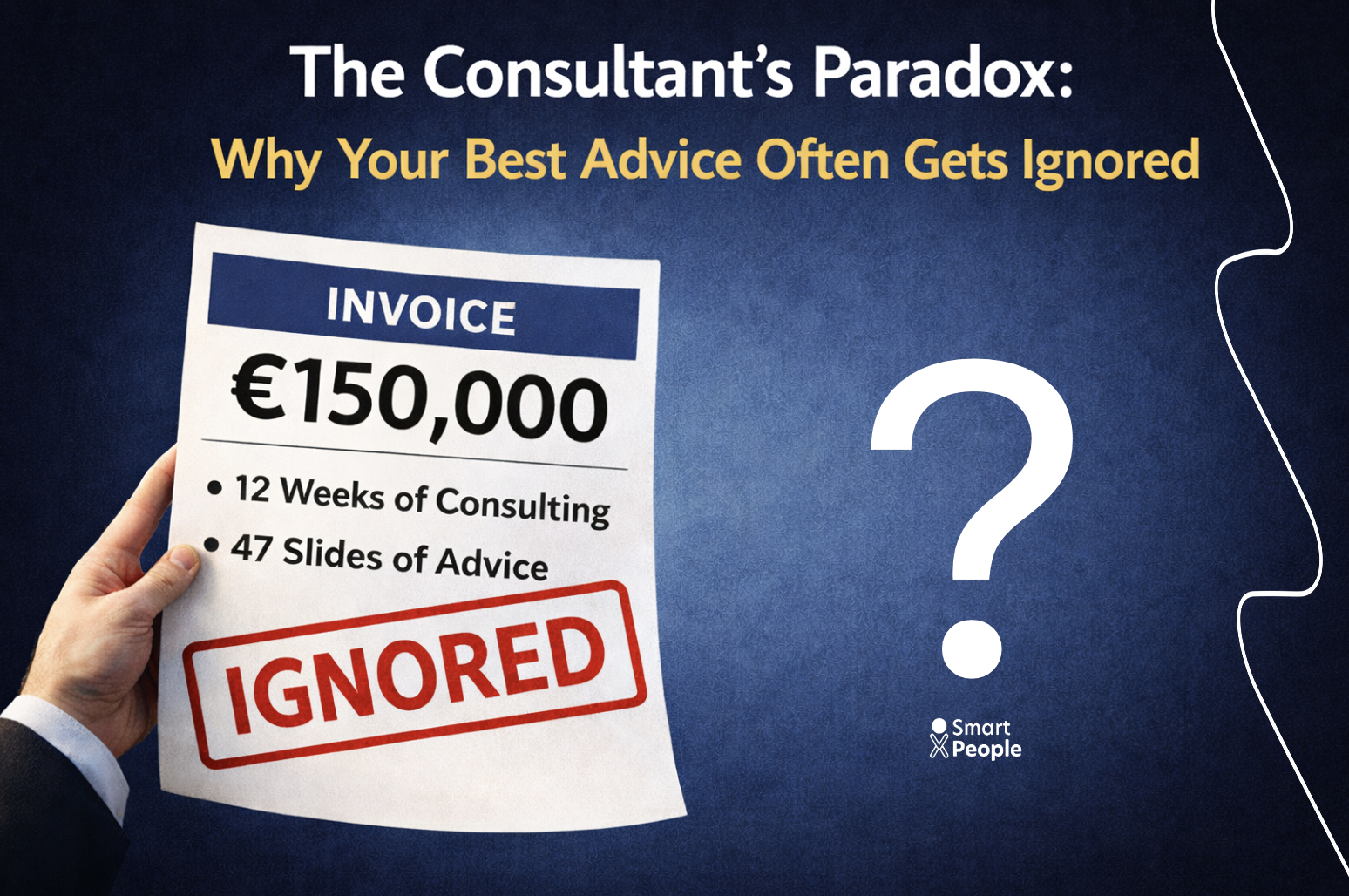
Imagine this: a client pays €150,000 for a 3-month consulting project.

Your team spends 12 weeks analyzing processes, interviewing stakeholders, and crafting 47 slides full of data and recommendations.

The main advice: "Restructure the sales department and change the compensation model – this is the root cause."

CEO nods thoughtfully. At the end, he says:

"Excellent work. We'll implement everything… except the restructuring. Too political."

€150k later, the client hears what they already knew.

Welcome to the consultant's paradox – it happens more often than you think.


Why Clients Really Hire Consultants

Most companies say: "We need external expertise."

The truth is different:

  1. Validation, not transformation

    Clients already know what they want. They just need someone outside to say: "You're right."

    Example: a CTO wants to move to the cloud. Decision already made. McKinsey confirms it. €200k for a stamp of approval.
  2. Political cover

    "I need to lay off 30 people. If I say it – I'm the bad guy. If a consultant says it – business necessity."

    HBR: 23% of companies hire consultants to provide cover for unpopular decisions already made.

  3. Buying time

    "The board wants a decision. I'm not ready. Hire consultants to research the topic – buy six months."

    Looks proactive. Feels passive.


What Happens to the Best Advice

Typical scenario:

Consultant finds the root cause: "It's not the process. Four departments are duplicating efforts and competing with each other."

Recommendation: "Merge into one department."

What client actually implements:

  • New processes
  • Better tools
  • Team training
  • Restructuring (too hard, too political)

Result: 20% improvement, root cause still intact.

18 months later – same problem, new consultants.

Why ignore the best advice?

  • Too disruptive – power shifts, VP may get fired, admit past mistakes.
  • Sacred cows – legacy structures, long-term employees, founder's design.
  • Lack of courage – easier to tweak a process than tackle the real problem.

How Consultants Adapt

20 years in consulting shows a pattern:

  • Juniors: "I'll tell the truth!"
  • Seniors: "I know they won't implement it. I'll propose something they actually will."

The result:

  • Self-censored advice
  • "Doable" solutions over "right" solutions
  • Focus on what client accepts, not what client needs

What to Do

For Clients:

  1. Be clear: validation or transformation?
  2. Create safety for hard truths.
  3. Commit to top recommendations before seeing them.

For Consultants:

  1. Diagnose real intent in week one.
  2. Present options, not one "right" answer.
  3. Separate recommendations from what client will actually do – give a safe exit.

The Uncomfortable Truth

Consulting works because:

  • Clients don't implement everything
  • Problems return every few years
  • More consultants are hired

If all clients implemented 100% of recommendations, the consulting industry would be half its size.

Exceptions exist: the best clients are honest, create safety, and actually implement tough changes.

The best consultants speak truth, don't self-censor, and deliver real results.

The consultant's paradox isn't a bug. It's a feature of the system.

Ready for Real Transformation?

Smart People Global Academy delivers SAP SuccessFactors training that organizations actually implement.

Learn more at smartpeople-global.com

Questions? Contact:
Piotr Ławrynowicz
piotr.lawrynowicz@smartpeople.com.pl
LinkedIn