
Fachkräftemangel. Or: How German HR Managers Are Learning to Live with a Problem They Can't Solve.
By Piotr Ławrynowicz | VP Strategic Growth, Smart People
Germany has a problem it knows well — and still cannot solve with traditional instruments.
86% of German companies are struggling to find talent — well above the global average of 74%. The country that built its reputation on engineering excellence and operational precision now leads the global ranking in talent shortages.
This is not a failure of HR. It is the collision between demographic reality and organizational design.
A precision economy with a structural capacity gap.
And structural gaps require structural responses.
The Numbers Every HR Director in DACH Should Find Uncomfortable
Structural scarcity — by the numbers
In June 2025, Germany had 391,000 unfilled positions. Statistically, every third open role could not be properly staffed. (IQB)
In IT alone, approximately 109,000 specialists are currently missing. 85% of companies report shortages, and 79% expect the situation to get worse. (Bitkom)
The Institut der deutschen Wirtschaft projects that by 2028, the number of unfilled positions will reach 768,000 — a 58% increase in just four years. (Südwestfalen)
These numbers do not describe recruiting inefficiency. They describe structural scarcity.
Germany does not primarily suffer from a talent shortage. It suffers from an operating model that assumes talent will always be available on time. And scarcity changes the rules of operations.
This is not cyclical. It is demographic and long-term. No hiring campaign will correct it quickly enough.
The Classic Response to a Structural Problem
Most organizations respond in a disciplined, entirely logical way:
The standard playbook — and where it breaks
- Open a requisition.
- Define the ideal profile.
- Align budget.
- Run the process.
- Wait.
This approach works — when the market works. But when supply structurally lags demand, the timeline of recruitment and the timeline of operations start to diverge.
Meanwhile: projects must move. Systems must run. Compliance obligations remain. Transformation roadmaps do not pause.
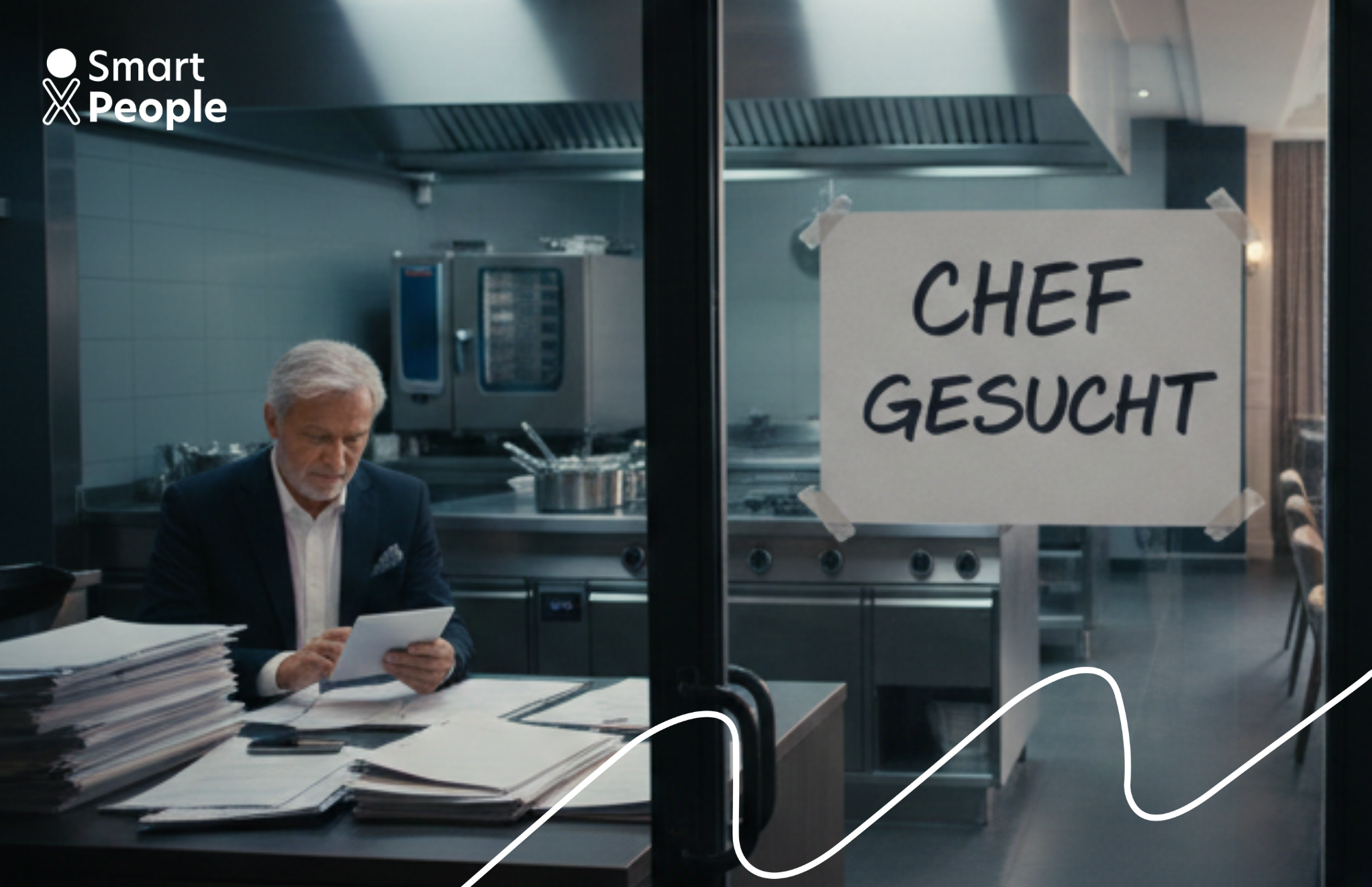
Think of a restaurant that, instead of cooking, is looking for a chef. The process may be correct. The governance may be flawless. But guests are still waiting.
This is not mismanagement. It is a mismatch between process speed and market reality. And in HR IT environments, that mismatch becomes visible very quickly.
Why Mittelstand Is Particularly Exposed
The pressure has shifted — DIHK Fachkräftereport 2025/2026
While talent shortages were previously most acute in large enterprises, the pressure has now clearly shifted toward the Mittelstand. More than 40% of companies with over 20 employees report difficulties filling open positions.
Large corporations often have global mobility programs, employer branding scale, and internal talent pipelines. Mid-sized companies frequently operate with leaner structures and less redundancy.
Yet they implement the same enterprise-grade HR platforms — SAP SuccessFactors, Workday and others — with the same expectations for stability and performance.
The result is not necessarily a shortage of people. It is a shortage of operational redundancy.
And redundancy, in complex systems, is not waste. It is resilience.
An Operational Response to a Structural Problem
An external team is not outsourcing. It's an operational decision.
The companies navigating this environment most effectively are not abandoning corporate governance or hiring discipline. They are complementing it.
A stabilizing layer — not a replacement
Instead of waiting for a single profile that the market cannot reliably supply, they temporarily integrate an external team with established competencies and internal coordination.
Not as a replacement for internal talent. Not as a permanent dependency. But as a stabilizing layer.
This approach does not disrupt corporate order. It protects it.
In a structurally scarce market, designing continuity into the system is more rational than hoping to hire it.
83% of companies expect negative consequences from talent shortages in the years ahead. (DIHK)
The question is no longer: "Will we eventually hire?"
The more strategic question is: "How do we ensure continuity, governance and delivery even when the labor market does not cooperate?"
Let's Talk
If you're navigating talent scarcity in a DACH HR IT environment — or thinking about how to build operational continuity into your next project — reach out.
It's a conversation, not a pitch.
Write to Me