
27Jan

The End of the Employee

THE END OF THE EMPLOYEE - Why Companies Will Be Networks, Not Hierarchies

The End of The Employee

(Why Companies Will Be Networks, Not Hierarchies)


The org chart hanging in your HR department is fiction.

Not because it's inaccurate—though it probably is—but because it represents a model of work that's disappearing in real time.

The concept of "the employee" as we know it—someone who works full-time, sits in an office (or logs into Zoom from the same place every day), reports to a single manager, and stays with one company for years—is becoming the exception, not the rule.

By 2030, most work won't be done by traditional employees. It will be done by networks of talent: some full-time, some part-time, some project-based, some advisory. Companies won't be pyramids of people. They'll be platforms orchestrating capability.

This isn't a prediction. It's already happening.


Why The Traditional Employment Model Is Breaking

The employment model we inherited was built for manufacturing economies and mass production. You needed people in one place, doing predictable work, under direct supervision.

That model is colliding with four unstoppable forces:

Force 1: The Economics Don't Work Anymore

Hiring a full-time employee in 2026 costs far more than salary:

  • Recruitment: €15–25k for senior roles
  • Onboarding: 3–6 months to productivity
  • Benefits: 25–40% on top of salary
  • Office space: €5–10k per person annually
  • Risk: if they leave in the first year, the cycle starts again

Research shows that 84% of companies struggle to find skilled talent locally. You're paying premium prices for limited local talent while global expertise sits idle.

And most likely, you need that specialized skill only 40–60% of the time—but you're paying for 100%. The math doesn't add up.

Force 2: Talent Wants Flexibility More Than Stability

The employee value proposition has flipped.

Twenty years ago, people traded flexibility for job security. Today, 78% of workers prioritize work-life balance over salary. Remote and hybrid employees report higher satisfaction than office-bound colleagues, and 21% of companies plan to hire internationally because local talent isn't enough.

Top talent increasingly doesn't want traditional employment. They want:

  • Project-based work that keeps them learning
  • Multiple income streams instead of dependence on one employer
  • Geographic freedom
  • Control over their time

Companies clinging to "9–5 in the office" aren't competing with other firms—they're competing with freelancing, fractional work, and entrepreneurship.

Force 3: Work Itself Has Changed

Work has shifted from routine to dynamic.

In manufacturing economies, work was repetitive. Train someone once, and they could do the same task for years. Pyramid structures made sense.

In knowledge economies, work is project-based. Different problems require different capabilities. Yesterday's team structure won't solve tomorrow's challenges.

Companies are discovering that fixed headcount is a liability, not an asset. You either:

  • Carry expensive bench time during slow periods
  • Scramble to hire when opportunities arise (losing 4–6 months)
  • Miss opportunities entirely

Fluid capability beats fixed headcount every time.

Force 4: AI Accelerates Change

The rise of artificial intelligence accelerates the end of the traditional employee. AI tools can perform analytical tasks, support decision-making, create content, or even co-develop product initiatives—often faster and more accurately than full-time staff. This changes both the cost of employment and the role humans play in the organization. In talent networks, AI becomes a "team member," supporting core and extended teams, enabling human specialists to focus on strategic and creative work instead of repetitive tasks.


What Replaces The Employee

The future isn't "everyone becomes a freelancer." It's more nuanced.

Successful companies in 2030 will operate as three-layer networks:

Layer 1: The Core Team

Small, permanent, deeply integrated. They:

  • Hold institutional knowledge
  • Make strategic decisions
  • Maintain culture and values
  • Coordinate the extended network

Think 20–30% of current headcount. Full-time, benefits, long-term commitment. They orchestrate capability, not do all the work.

Layer 2: The Extended Network

Embedded specialists who work consistently but not exclusively:

  • Senior consultants on 3–6 month rotations
  • Fractional executives (CFO, CTO, CHRO 2–3 days/week)
  • Specialized teams (e.g., data science squad for a project)

They integrate with your tools, attend meetings, report to management—but are not permanent employees. Think 40–50% of your capability needs.

Team-as-a-Service (TaaS) shines here: senior talent operational in weeks, scaling down when projects end. No layoffs, no politics. Just capacity that matches demand.

Layer 3: The Flexible Pool

On-demand experts for specific, short-term needs:

  • UX researcher for a 3-week sprint
  • Regulatory specialist for compliance review
  • Technical writer for documentation

Think 20–30% of needs. Engaged for days or weeks, not months.


Why This Isn't Just "Outsourcing 2.0"

Old Outsourcing:

  • Cost arbitrage (cheaper labor overseas)
  • Transactional vendor relationships
  • Low-skill, repetitive work
  • Managed via contracts and SLAs
  • Cultural disconnect

New Network Model:

  • Capability arbitrage (access to global expertise)
  • Integrated team relationships
  • High-skill, strategic work
  • Managed through collaboration and outcomes
  • Cultural alignment is explicit

Old outsourcing was about doing the same work cheaper. The new model is about accessing capabilities you couldn't afford to maintain full-time.


The Implications Are Massive

Organizational Structure:

Forget org charts. Think capability maps. Ask: "What skills do we need, and where do we source them?"

Performance Management:

You can't manage by presence. Focus on orchestration:

  • Clear outcomes, not processes
  • Async communication
  • Trust over control
  • Results over hours

Culture:

Strong culture is based on:

  • Shared values
  • Clear mission
  • Recognition systems for all work models
  • Deliberate relationship-building

Talent Strategy:

Shift from "talent acquisition" to "talent access." Build networks of trusted specialists, onboarding for temporary integration, and financial planning for variable capacity.


What This Means For Companies

Transitioning from traditional employees to networked talent is uncomfortable but advantageous:

  • SPEED: Deploy capability in weeks
  • FLEXIBILITY: Scale up/down as needed
  • ACCESS: Global expertise over local pools
  • COST: Pay for capability when needed
  • RISK: Reduce hiring mistakes, market exposure, project failures

The Future Is Hybrid

Core teams will remain, full-time roles will exist, but smaller, strategic, and surrounded by flexible networks. Success will favor orchestration, not headcount. Companies will act like conductors, assembling the right talent for each challenge.

The question isn't whether this future is coming—it's whether you're building your company to operate in it.


Ready To Build Your Network Model?

At Smart People, we help companies transition from fixed headcount to flexible capability networks.

Team-as-a-Service delivers:

  • Senior, vetted talent operational in 14 days
  • Embedded teams integrating with your culture and tools
  • Flexible scaling (up/down with 30-day notice)
  • Zero HR risk

📧 piotr.lawrynowicz@smartpeople.com.pl

🔗 smartpeople.com.pl
20Jan

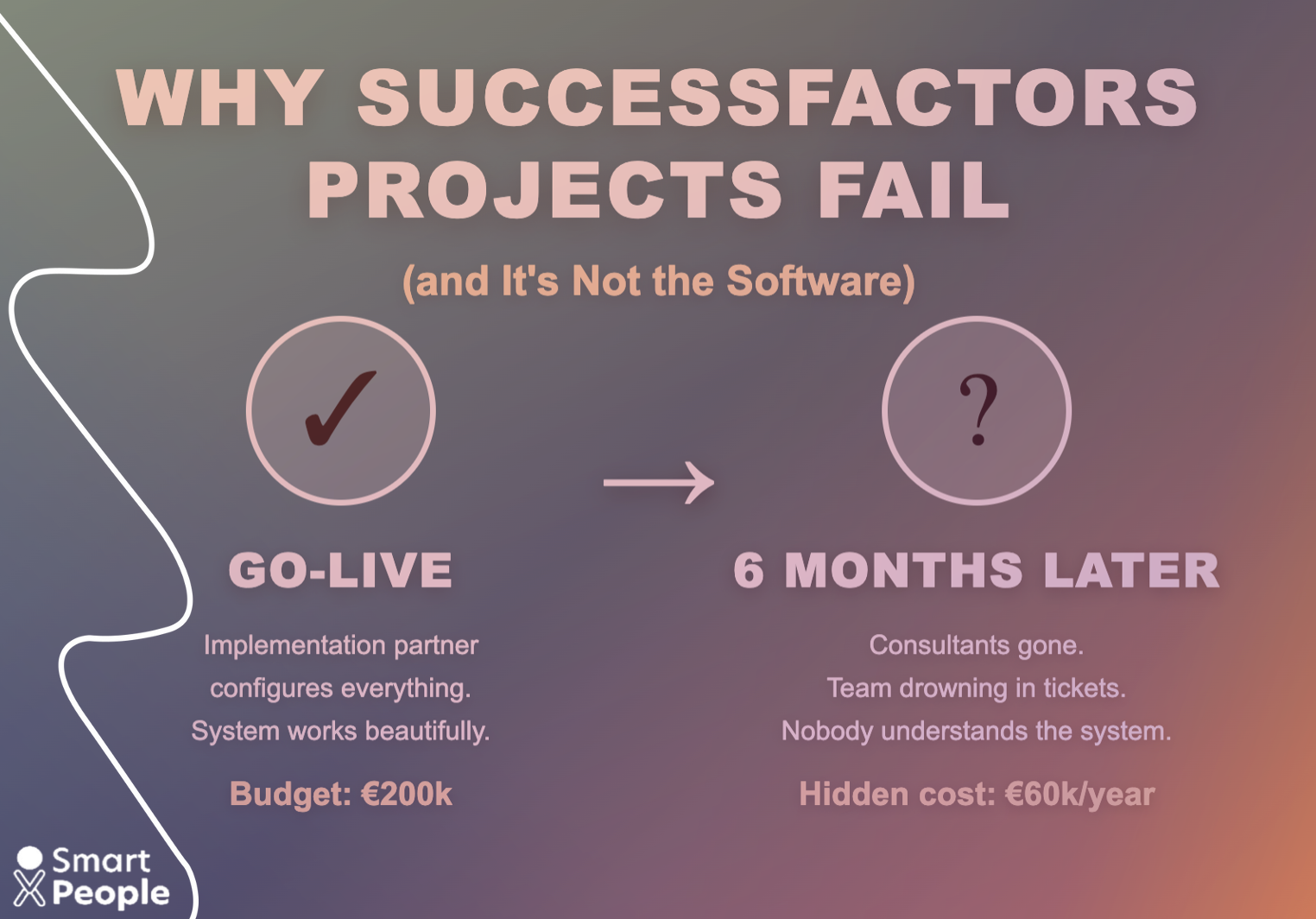
Why SuccessFactors Projects Fail (and It’s Not the Software)

Why SuccessFactors Projects Fail (and It's Not the Software)

Why SuccessFactors Projects Fail (and It's Not the Software)

I've watched this pattern repeat dozens of times:

A company buys SuccessFactors. Budget approved. Licenses signed. Implementation partner hired.

Six months later: go-live.

Twelve months later: the implementation partner is long gone, the system works "sort of," and your internal team is drowning in tickets they don't know how to resolve.

Eighteen months later: SAP releases a major update. Your team panics because nobody understands what will break.

Sound familiar?

Here's the thing most companies get wrong: SuccessFactors projects don't fail because of the software. They fail because of what happens AFTER the consultants leave.


The "Black Box" Problem

Let me give you a metaphor.

Imagine you buy a high-performance car. You hire a mechanic to tune it perfectly. He does an amazing job – the car runs beautifully.

Then he leaves.

Three months later, a warning light comes on. You open the hood. You have no idea what you're looking at.

You call the mechanic. He's busy with another client. "I can come back in two weeks. My rate is €1,500 per day."

This is what happens with most SuccessFactors implementations.

The implementation partner configures everything. They make it work. But they don't transfer the knowledge. Your internal team watches from the sidelines, takes some notes, attends a few workshops.

Then go-live happens. The consultants leave. And your team is alone with a system they don't truly understand.


Three Ways This Goes Wrong

1. Your Team Doesn't Know What They Don't Know

During implementation, your internal team thinks they're learning. They attend configuration sessions. They see how the consultant sets up Employee Central, configures Role-Based Permissions, maps integrations.

But watching someone configure is not the same as understanding WHY it's configured that way.

When something breaks – and it will – your team doesn't know where to look. They don't understand the dependencies. They don't know which settings cascade to other modules.

Result: Every issue becomes an escalation to the implementation partner. At premium rates.

2. The "It Worked Yesterday" Syndrome

SAP releases SuccessFactors updates twice a year. 250+ new features. Deprecations of old functionality. Changes to APIs, security protocols, data models.

If your team doesn't understand the system deeply, every release is a potential catastrophe.

I've seen companies where the internal team is afraid to apply updates because they don't know what will break. So they postpone. And postpone. Until they're so far behind that catching up becomes a massive project.

Meanwhile, they're paying for new features they can't use because they're stuck on an old release.

3. The Knowledge Evaporates

Here's the worst part: even if your team learned something during implementation, that knowledge evaporates over time.

People leave. The one person who understood how payroll integrations work takes a new job. The admin who configured Performance & Goals goes on maternity leave.

Six months later, you need to make a change. Nobody remembers how it was set up. The documentation (if it exists) is incomplete.

You're back to square one: calling expensive consultants to figure out your own system.

Why This Keeps Happening

Most implementation partners are incentivized to deliver the project, not sustainable capability.

Their KPIs are:

  • Go-live on time? ✅
  • Within budget? ✅
  • System functioning? ✅

What's NOT in their KPIs:

  • Can the client manage this without us? ❌
  • Does the internal team understand the architecture? ❌
  • Will they be ready for the next release? ❌

I'm not saying implementation partners are doing this maliciously. It's just the business model. They move from project to project. Your team gets six months of exposure, not six months of mastery.


What Actually Works: Knowledge Transfer as Strategy

After years in B2B sales and HR tech, I've learned this: The best implementations are the ones where the client knows what they're doing.

Not because they're tech geniuses. Because someone invested in making sure they actually learned.

Here's what this looks like in practice:

Before Implementation: Targeted Training

Don't send your team into implementation blind. Give them structured training BEFORE the project starts.

Not generic "Introduction to SuccessFactors" webinars. Targeted, hands-on training in the modules you're actually implementing:

  • Employee Central configuration
  • Integration fundamentals
  • Role-Based Permissions architecture
  • Whatever your project needs

When implementation starts, your team isn't just watching. They're active participants who understand what's happening.

During Implementation: Embedded Learning

The best model I've seen: hybrid squads.

Your internal team works alongside experienced consultants. Not as observers – as co-implementers.

The consultant configures Employee Central? Your admin does it WITH them, not just watches.

The consultant maps integrations? Your IT person is hands-on, learning the logic, not just taking screenshots.

This is slower than having consultants do everything. But the ROI is massive because your team is building real capability, not just checking boxes.

After Go-Live: Structured Handoff

Go-live should not be "consultants leave, good luck."

It should include:

  • Documented architecture (not just "what" but "why")
  • Runbooks for common issues
  • Clear escalation paths
  • Post-go-live support period where your team handles issues with consultant backup

Think of it as training wheels, not abandonment.


The ROI Math Nobody Talks About

Let's run the numbers on a typical medium enterprise project (500–2,000 employees, standard modules: Employee Central, Payroll, Performance).

Scenario A: Standard Implementation

  • Implementation cost: €200k
  • Internal team: minimal training
  • Post-go-live: consultant calls at €1,500/day
  • Average: 40 days/year = €60k annual "hidden cost"
  • Over 3 years: €180k in reactive consultant fees

Scenario B: Knowledge-Transfer Implementation

  • Implementation cost: €220k (includes embedded training)
  • Internal team: deeply trained, confident
  • Post-go-live: 80% of issues handled internally
  • Consultant needs: ~10 days/year = €15k
  • Over 3 years: €45k in consultant fees

Savings over 3 years: €135k

Note: These numbers are based on typical projects for companies with 500–2,000 employees using standard modules. For large, multi-country implementations, numbers may be higher; for smaller projects, lower.

And that's not counting:

  • Faster issue resolution (internal team responds immediately, not "wait for consultant availability")
  • Confidence to adopt new releases (your team understands the system)
  • Ability to optimize over time (you're not stuck with "how the consultant did it")

What I've Learned Over the Years

The companies that get the most value from SuccessFactors aren't the ones who hired the fanciest implementation partner.

They're the ones who treated implementation as a capability-building exercise, not just a technology deployment.

They invested in:

  • Training their people BEFORE the project
  • Embedding learning DURING the project
  • Structured handoff AFTER go-live

And yes – sometimes they augmented with external consultants when they needed specific expertise. But those consultants worked alongside the internal team, transferring knowledge, not creating dependency.


If you're planning a SuccessFactors project – or struggling with one you've already launched – ask yourself this:

"If my implementation partner disappeared tomorrow, could my team keep this system running?"

If the answer is "probably not" – you don't have a SuccessFactors system.

You have an expensive dependency.


Need a Different Approach?

At SmartPeople, we don't just deliver projects. We build capability.

Our model combines:

  • Targeted SuccessFactors training for your team (hands-on, module-specific)
  • Project squads of certified consultants who work WITH your team, not instead of them
  • Knowledge transfer as a deliverable, not an afterthought

Typical payback: 7 months for companies that engage their internal team in knowledge transfer from day one. ROI can be faster (4–6 months) for large organizations with high ongoing support costs, or longer (12–18 months) for companies with low external support spending.

Because you're not just buying a working system – you're building a team that can evolve it.

Planning a SuccessFactors project? Let's talk about knowledge transfer, not just implementation.

Piotr Ławrynowicz
LinkedIn
10Nov

Headcount Metrics Are Sabotaging Your Growth: The Case for Capacity Planning

Headcount Metrics Are Sabotaging Your Growth: The Case for Capacity Planning
The board asks: “How many people do we have?” The CFO answers: “247 FTEs.” And nobody asks the only question that actually matters: “How much can we actually deliver this quarter?”

Headcount Metrics Are Sabotaging Your Growth: The Case for Capacity Planning

The board asks: “How many people do we have?”
The CFO answers: “247 FTEs.”
The board nods. The CFO sits down.

And nobody asks the only question that actually matters:
“How much can we actually deliver this quarter?”

Welcome to the theater of financial planning, where everyone measures the wrong thing with extraordinary precision.


The FTE Trap

For decades, headcount has been the universal language of business planning.
Investors ask about it. Boards track it. Analysts model it.
Revenue per employee. Cost per FTE. Headcount growth rate.

These metrics feel solid. Quantifiable. Comparable across companies and industries.

There’s just one problem:
They tell you almost nothing about your actual capacity to execute.

Real scenario from a $180M software company:

  • Headcount: 340 FTEs
  • Engineering team: 87 people
  • Open roles: 14 (5 months average time-to-fill)
  • Engineers on parental leave: 3
  • Engineers serving notice period: 4
  • New hires in onboarding (weeks 1-8): 6
  • Actual productive engineering capacity: ~60 people

The CFO reports 87 engineers to the board.
The reality? They have 69% of that capacity available for actual work.

And that 31% gap?
It’s invisible in every financial model, every board deck, every investor presentation.

But it’s destroying the roadmap, delaying launches, and bleeding revenue into the void between what the org chart says you have and what you can actually deliver.


The Capacity Mirage

Here’s what traditional headcount metrics miss:

Ramp Time

A new senior engineer takes 3-6 months to reach full productivity.
During that time, they’re consuming capacity (onboarding, questions, code reviews) while producing at 20-40% effectiveness.

Your headcount says +1.
Your capacity says -0.2 for six months, then +1.

Attrition Lag

Someone gives notice. You start recruiting.
Average tech hiring cycle: 4-6 months.

Your headcount shows -1 today.
Your capacity shows -1 for the next six months minimum.
Add the new hire’s ramp time: you’re at reduced capacity for 9-12 months.

One departure doesn’t cost you one person-quarter.
It costs you three to four person-quarters of delivery capacity.

Skill Mismatch

You have 15 developers.
You need 3 React specialists, 2 Python engineers, 4 DevOps pros, and 6 backend Java developers.

You have: 8 Java, 4 React, 2 Python, 1 DevOps.

Your headcount says: “We’re fully staffed.”
Your capacity says: “We can’t ship three of our four priority projects.”


The Hidden Multiplier Effect

But the real damage isn’t in the individual gaps.
It’s in how those gaps cascade through your entire operation.

Case study: European fintech, €90M revenue

Q1 Plan:

  • Launch new payment gateway (Priority 1)
  • Migrate legacy system to cloud (Priority 2)
  • Build mobile app v2 (Priority 3)
  • Ship 47 customer-requested features (ongoing)

Engineering headcount: 52 people
Projected capacity: 52 FTEs × 3 months × 0.75 (accounting for meetings, support) = ~117 person-months

Sounds doable.

Q1 Reality:

  • 2 key architects left in December (exit + recruiting + onboarding = -24 person-months)
  • 3 engineers on sick leave (combined 8 weeks = -6 person-months)
  • 1 critical system outage consumed 2 weeks of team time = -26 person-months
  • 4 new hires ramping up (at 30% productivity) = -8.4 person-months

Actual available capacity: 52.6 person-months
That’s 45% of the plan.

Result:

  • Payment gateway delayed to Q2
  • Cloud migration postponed to Q3
  • Mobile app v2 cut entirely
  • 31 of 47 features shipped
  • Customer satisfaction dropped 18 points
  • Two major clients didn’t renew (€2.1M ARR lost)

The board looked at the headcount number (52 engineers) and asked, “Why aren’t we executing?”

Because headcount is a comfortable lie.
Capacity is the uncomfortable truth.


The Financial Impact Nobody’s Modeling

Let’s translate this into CFO language: cash and opportunity cost.

Scenario: You need to ship a new product feature to close a €5M enterprise deal.

The feature requires:

  • 2 senior backend engineers (8 weeks)
  • 1 frontend specialist (6 weeks)
  • 1 DevOps engineer (4 weeks)

Option A: Use Internal Team

Current situation:

  • Backend team: 8 people, all fully allocated
  • Frontend: 5 people, 1 person has 40% capacity available
  • DevOps: 3 people, all fully allocated

You can’t pull people without deprioritizing other work.
You open 2 req positions.

Timeline:

  • Post jobs: Week 1
  • Screen candidates: Weeks 2-6
  • Interview and offer: Weeks 7-10
  • Notice period: Weeks 11-14
  • Onboarding: Weeks 15-18
  • Ramp to productivity: Weeks 19-26
  • Feature delivered: Week 30 (7.5 months)

Financial impact:

  • Hiring costs: €45K
  • Fully loaded salaries for 7.5 months: €180K
  • Deal lost to competitor: €5M
  • Net impact: -€5.225M

Option B: Deploy TaaS Capacity

  • Engage blended team (2 senior + 1 mid + 1 DevOps): Week 1
  • Onboard and integrate: Week 2
  • Development: Weeks 3-10
  • QA and deployment: Weeks 11-12
  • Feature delivered: Week 12 (3 months)

Financial impact:

  • TaaS engagement cost (3 months): €120K
  • Deal closed: +€5M
  • Net impact: +€4.88M

The difference isn’t in the hourly rate.
It’s in the €10.1M swing between measuring headcount and measuring capacity.


The New Financial Model: Capacity as Infrastructure

Smart CFOs are rebuilding their financial planning around a single principle:

Stop counting people. Start measuring deployable capacity.

This means tracking:

1. Available Capacity (AC)
Not how many people you employ, but how many productive person-weeks you can deploy right now.

Formula: AC = (Total headcount × Available hours) – (Ramp time + Transition costs + Inefficiency overhead)

2. Required Capacity (RC)
What execution capacity your roadmap actually demands, broken down by skill and timeline.

3. Capacity Gap (CG)
The difference between RC and AC, measured in person-weeks and financial impact.

4. Capacity Acquisition Cost (CAC)
What it costs to close the gap: hiring, training, TaaS engagement, or deprioritization.

5. Capacity Velocity (CV)
How fast you can deploy new capacity when needs change.

This isn’t theoretical.
It’s how modern finance teams model operational reality.


Real Numbers: The Capacity P&L

Here’s what this looks like in practice for a mid-sized B2B SaaS company:

Traditional FTE Model:

  • Revenue: €45M
  • Headcount: 180 FTEs
  • Revenue per employee: €250K
  • Looks healthy

Capacity Model:

  • Revenue: €45M
  • Available productive capacity: 112 person-years (after accounting for ramp, attrition, mismatch)
  • Revenue per unit of capacity: €402K
  • Capacity utilization: 62%
  • Unfilled capacity need: 38 person-years
  • Revenue constrained by capacity, not demand

With capacity lens, the real questions emerge:

  • “What’s our capacity to revenue conversion rate?”
  • “Where are our capacity bottlenecks?”
  • “What’s the ROI of deploying additional capacity?”
  • “Can we access capacity faster than we can hire?”

These questions lead to very different decisions.


The TaaS Capacity Arbitrage

This is where Team-as-a-Service shifts from “nice to have” to “structural advantage.”

Because TaaS doesn’t add headcount.
It adds instantly deployable capacity with near-zero ramp time.

Traditional hiring:

  • Decision to fill role: Week 0
  • Capacity available: Week 26
  • Capacity velocity: 0.038 person-years per week

TaaS engagement:

  • Decision to deploy: Week 0
  • Capacity available: Week 2
  • Capacity velocity: 0.48 person-years per week

That’s 12.6x faster capacity deployment.

For a CFO, this transforms the financial model:

You’re no longer optimizing cost per employee.
You’re optimizing capacity deployment speed and capital efficiency per unit of delivered capability.

Example: SaaS company targeting €60M → €100M revenue

Growth requires:

  • 40 additional person-years of engineering capacity
  • 15 person-years of sales capacity
  • 8 person-years of customer success capacity

Path A: Traditional Hiring

  • Total hiring: 63 people
  • Fully loaded cost year 1: €6.3M
  • Time to full capacity: 18 months
  • Risk: Market moves, priorities shift, permanent cost base

Path B: Hybrid Model (40% TaaS)

  • Hire 38 core people: €3.8M
  • Deploy 25 person-years via TaaS: €2.5M
  • Total cost year 1: €6.3M
  • Time to full capacity: 6 months
  • Flexibility: Scale TaaS component up/down based on actual demand

Same budget.
3x faster capacity deployment.
Variable cost structure that moves with revenue.

This is the arbitrage: speed and flexibility without additional capital.


The Board Question That Changes Everything

Next time you’re in a board meeting and someone asks about headcount, try this:

“We have 247 FTEs. But the more important question is: we have 186 person-years of deployable capacity this quarter, with 34 person-years of unfilled capacity demand. We’re addressing that gap through a combination of strategic hiring and on-demand TaaS engagement, which gives us 4-month faster capacity deployment at 15% lower fully-loaded cost.”

That’s not HR speak.
That’s financial planning that actually connects to execution.


2026: The Capacity-First CFO

The next generation of finance leaders won’t be measured by cost control.
They’ll be measured by capacity orchestration.

  • How fast can you deploy the right skills?
  • How flexibly can you reallocate resources?
  • How efficiently can you convert capacity into revenue?

Companies still measuring headcount are playing yesterday’s game.
Companies measuring capacity are building tomorrow’s competitive advantage.


The Bottom Line

Your org chart shows 300 people.
Your capacity reality might be 180 productive person-years.

That 40% gap isn’t a rounding error.
It’s the difference between hitting your revenue target and explaining to the board why “fully staffed” teams missed every deadline.

Headcount is a vanity metric.
Capacity is a financial weapon.

The question isn’t how many people you have.
It’s how much you can actually deliver—and how fast you can deploy more when it matters.

Because in a world where speed beats efficiency, the CFO who masters capacity planning doesn’t just optimize costs.

They become the architect of strategic advantage.

Ready to Transform Headcount into Deployable Capacity?

Want to see how capacity-first planning and TaaS can unlock your growth?
Deploy productive capacity in 2 weeks. Scale up or down by the quarter. Pay for delivery, not promises.

📧 piotr.lawrynowicz@smartpeople.com.pl

PS: The most sophisticated CFOs in Europe have already made the shift from headcount metrics to capacity planning. The question is: will you lead this transformation in your organization—or explain to the board why your “fully staffed” teams keep missing targets?
“`
03Nov

Digital Empires: How Global Corporations Became the Sovereigns of Competence

Digital Empires: How Global Corporations Became the Sovereigns of Competence
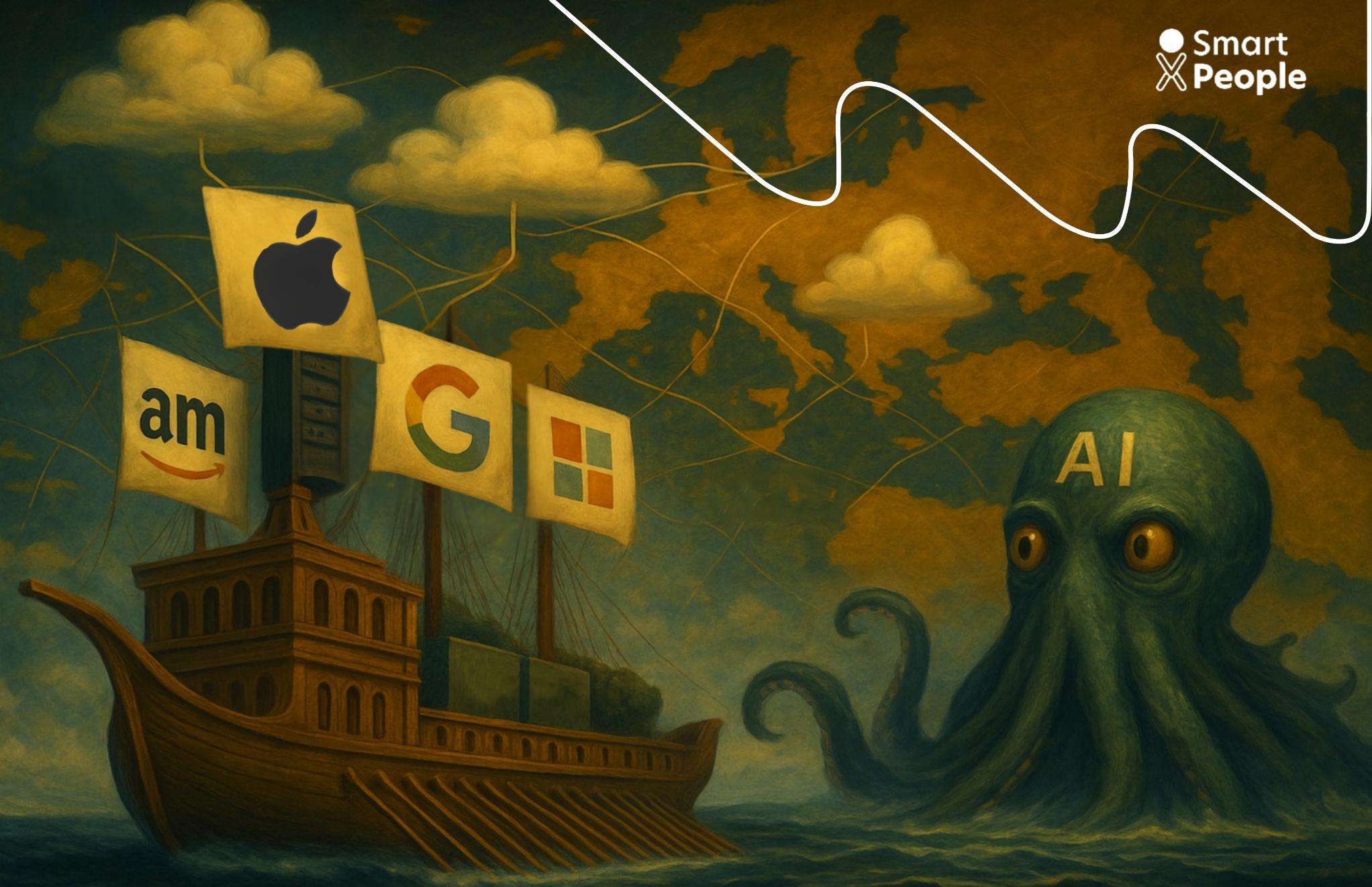
In the 16th century, whoever controlled the sea routes controlled the spice trade. Today, those who control digital infrastructure and access to competence control the pace and direction of the game.

Digital Empires: How Global Corporations Became the Sovereigns of Competence

In the 16th century, whoever controlled the sea routes controlled the spice trade.
The fleets dictated the price of pepper in London and silk in Venice.

Today, ships have been replaced by servers, ports by the cloud, and East India companies by tech giants that control something far more valuable than spices — access to knowledge and competence.

Amazon, Google, Microsoft, Tencent — these are no longer companies.
They are digital empires with their own laws, infrastructure, and influence that reach far beyond national borders.

And just as merchant cities once had to negotiate with colonial fleets, companies relying on external expertise must now realise that their suppliers are no longer subcontractors — they are strategic allies in a world where skills are currency and time is a luxury no one can afford.


Digital Sovereigns and the New Rules of Power

When Amazon changes AWS policies, tens of thousands of businesses worldwide adjust overnight.
When Meta tweaks its moderation algorithms, marketers in Warsaw, San Francisco, and Mumbai rebuild campaigns by Monday.

These are not suggestions — they are decrees, operating with the force of sovereign authority.

The difference?

No one elected them. Yet their influence over business operations exceeds that of many governments.

Just like in the Age of Exploration — those who controlled the routes controlled the trade — today, those who control digital infrastructure and access to competence control the pace and direction of the game.


TaaS: Your Fleet of On-Demand Competence

In this world of digital empires, Team-as-a-Service (TaaS) is the modern equivalent of the Renaissance condottieri — mercenary formations for hire.

But instead of soldiers, you command AI engineers, SAP experts, and market strategists.
And instead of year-long contracts — a call, two days of due diligence, and your team is ready on Monday.

Real-World Example:

A global fintech plans to expand into Southeast Asia.
It needs senior IT talent, local compliance experts, SAP specialists.

Traditional hiring?
Three to six months, HR risk, onboarding costs, uncertainty.

TaaS?
A blended team from Poland, Germany, and Singapore — onboarded in two weeks.
Fully integrated with the client's systems.
Paid for results, not hours.

TaaS is your HR risk insurance and your response mechanism in an unstable world dictated by digital sovereigns.

It's not outsourcing — it's competence activation on demand.
You power up when needed, power down when done — predictable cost, zero HR risk, full control.


Not Everything That Glitters Is Gold

But just as the condottieri could switch sides mid-battle, the TaaS model comes with its pitfalls.
Not every provider is trustworthy. Not every contract is safe.

Critical Risk Factors:

Compliance & Data Security — ISO and SOC2 are not résumé decorations; they are tickets to the table.
Each jurisdiction has its own rules — what's acceptable in Singapore may fail an audit in Frankfurt.
GDPR in Europe, fragmented privacy laws in the US, evolving frameworks in China and Japan — your TaaS provider must juggle them all simultaneously.

Reputation Management — Relying too heavily on one vendor is like mooring every ship in the same harbour during a storm. Diversify, define clear SLAs, and keep exit clauses clean.

Trust & Transparency — Real-time dashboards, shared cloud workflows, visible KPIs — these are not add-ons anymore; they are the baseline for collaboration.

Companies that treat TaaS like traditional outsourcing ("delegate and forget") lose.
Those that build partnerships of trust and accountability — win.


2026: What's Next

The coming months will bring convergence — several trends reaching critical mass:

  1. Global Competence Without Borders — A team from Warsaw, Berlin, and Singapore operates as if sitting in one room. Geography is gone; competence remains.
  2. AI + Human = New Normal — Automation handles repetition. Experts focus on decisions. TaaS becomes a fusion of people and intelligent machines.
  3. Unprecedented Flexibility — Monthly contracts, pause options, team reshuffles in a week, success-based billing. Clients gain control like never before.
  4. Compliance as Entry Ticket — Certifications stop being "nice to have." They become market filters.
  5. Total Integration — Top TaaS teams don't work for the client; they work within the client.
    They attend all-hands, use internal tools, and report directly to management.

At SmartPeople, we call this the Embedded Team model.


The End of the Game — or the Beginning of a New Era?

Business moves faster than regulation. Governments struggle to keep pace with changes rolled out quarterly by digital sovereigns.

Organizations leveraging global TaaS must stop viewing providers as contractors.
They are strategic allies in a world where competence is currency and time is the rarest commodity.

The future of outsourcing isn't just about technology — it's about legal frameworks, operational standards, and trust models set by digital empires.

Those who understand this will gain everything:

  • Access to global talent
  • Flexibility in execution
  • Resilience in an era of volatility

Those who don't?
They'll become vassals in the empire of digital sovereigns — without control, without influence, without an edge.

The question is simple:
Which side will you choose?

Ready to Build Your Fleet of On-Demand Competence?

Want to see how TaaS and AI-powered teams can transform your operations?
Embedded teams ready in 14 days. Zero HR risk. Full KPI transparency.

📧 piotr.lawrynowicz@smartpeople.com.pl

PS: The best leaders in Europe already understand this shift. The only question is: will you be among the digital sovereigns — or among those negotiating passage through waters controlled by others?
13Oct

Digital Transformation is Dead. Welcome to AI Transformation

Author:  Piotr Ławrynowicz

Digitization was only the rehearsal. AI is the main act — and it’s already on stage.

Finance and Accounting — From Paper to Prediction

  • 2020: Scan the invoice, approve manually.
  • 2025: AI reads documents, books automatically, forecasts cash flow, and recommends next actions.
    The accountant becomes a business advisor — not a data-entry clerk.

HR — From Reactive to Predictive

  • 2020: ATS system, online forms, manual sourcing.
  • 2025: AI identifies candidates before HR posts a job ad, chatbots conduct interviews, and predictive analytics detects who’s about to resign.

Customer Service — From Response to Anticipation

  • 2020: Email support, ticketing, live chat.
  • 2025: AI resolves most issues autonomously, predicts problems before customers complain, and delivers real-time personalisation.

Dashboards vs. Decisions

According to IDC and McKinsey, by 2025 Polish managers spend up to 40% of their time analysing dashboards. Yet over 90% of those decisions are routine.

Instead of speeding up operations, data overload slows companies down — a new kind of “dashboard fatigue.”

  • AI handles routine decisions automatically,
  • flags only exceptions for human review,
  • and suggests concrete actions — not just “pretty charts.”

Example: instead of showing you a graph of declining sales, AI automatically raises the ad budget and notifies you — before you’ve even noticed the drop.

How to Build an AI-First Organisation

Strategy

  • Challenge every process — does it still make sense?
  • Design “AI-native,” not “digital-for-the-sake-of-it.”
  • Focus on collaboration between people and algorithms.

Technology

  • API-first architecture — everything must talk to AI.
  • Real-time data, not end-of-month reports.
  • Cloud scalability and resilience as the default, not a vision.

Organisation

  • New roles: AI Trainer, AI Auditor.
  • New skills: working with algorithms, fast decision-making.
  • New culture: from “we’ve always done it this way” to “does it still make sense?”

Real AI Transformations (Poland & Europe 2025)

  • Banking: AI credit scoring — hundreds of signals analysed, faster approvals (BNP Paribas, Santander pilots 2024–25).
  • Manufacturing: Predictive maintenance and auto-ordering parts (ABB, Siemens — Silesia, Western Europe).
  • Retail: Personalised pricing and offers (Żabka AI Engine, Amazon Go rollouts 2025).

Is Your Company Still Stuck in “Digital Transformation”?

🚩 Red Flags

  • You still say “let’s digitise X”.
  • No coherent AI strategy — only pilots and PoCs.
  • AI as a layer on top of outdated workflows.

✅ Green Flags

  • Every process is a candidate for automation or elimination.
  • AI-native strategy is embedded, not decorative.
  • Measured AI outcomes — not endless “proofs of concept.”

Practical Steps Toward AI Transformation

  • Weeks 1–2: List all routine decisions and processes.
  • Weeks 3–4: Identify everything that can be automated or eliminated.
  • Following months: Pilot, measure, iterate — keep challenging old assumptions.

Digitization was just the warm-up.
The real race starts when you stop building digital copies of the old world — and start designing entirely new ones.

Want to see how AI transformation could look in your business?
SmartPeople delivers KPI-managed AI adoption — from roadmap to measurable ROI.
Contact: piotr.lawrynowicz@smartpeople.com.pl

PS: Digital transformation didn’t die — it evolved. It was devoured by AI. And if your company is still “going digital,” it means only one thing: the competition is already going intelligent.

    GDPR Consent

    By submitting this contact form, I consent to the processing of my personal data by Smart People for the purpose of responding to my inquiry, in accordance with the principles set out in the Privacy Policy and pursuant to Regulation (EU) 2016/679 (GDPR). Providing my data is voluntary, but necessary for this purpose. I have been informed of my rights to access, rectify, and request the cessation of processing of my data.

    12Sep

    Meeting a Dead Expert. Just Another Tuesday in 2025

    Author: Piotr Ławrynowicz
    Imagine this: Sun Kai, co-founder of a tech company in Nanjing, regularly "talks" to his mother about daily struggles and work. He asks her for advice and support – and an AI avatar, using her voice, body language, and memories, reproduces her typical responses.

    There's just one catch: Sun Kai's mother passed away in 2019.

    Sounds like distant sci-fi? It's already reality. Sun Kai is using digital resurrection services – and he's not alone.

    Digital Resurrection for $30

    By 2025, digital resurrection services are widely available in China.

    $30
    Entry-level AI chatbot (199 yuan)
    1,000+
    Deployments by one company in 2025
    $79B
    Projected market value by 2034
    • Entry-level: from 199 yuan (~$30) for a simple AI-video or chatbot
    • Premium products: from several hundred to several thousand dollars
    • Industry estimates: over 1,000 deployments by just one company in 2025

    And this is no niche – the global digital legacy sector was valued at $22B in 2024, projected to hit $79B by 2034. Other forecasts predict a doubling from $15B in 2025 to $31B by 2030, with annual growth of 15%+.

    Case: SenseTime

    In March 2024, at a shareholder meeting of China's leading AI firm, their founder Tang Xiao'ou – who had died in December 2023 – took the stage. His AI avatar spoke in his voice and style, sparking both excitement and heated debate about ethics and corporate digital legacy.

    AI Experts in Your Slack

    This is no longer just a Chinese story – in Poland (and everywhere else), scenarios are emerging where a "dead employee" answers a junior's questions on Slack through AI-bots trained on the code, emails, and documents of past experts.

    In companies deploying knowledge retention AI, the digital "retiree" has a permanent seat on the team – boosting productivity and preserving know-how.

    Is Your Company Ready for "Immortal" Employees?

    Analysts predict that organizations will increasingly claim rights to knowledge, voice, and digital likeness of key experts after they leave – or after they die.

    Retention of knowledge: if AI can replicate an expert's knowledge and communication – why not keep them "forever"?

    Law, Risk, Regulation

    🇪🇺 EU – European AI Act

    From August 2, 2025, the EU requires explicit labeling of AI-generated content (deepfake, chatbot, AI avatar).

    🇺🇸 US – Colorado AI Act

    Colorado passed the first comprehensive law on AI in employment (enforcement: February 2026).

    Ethics, Risks, and "Deadbots"

    Philosophers and ethicists – like Prof. Michel Puech from Sorbonne – warn of over-reliance on deadbots and the risk to healthy grieving:

    "There's a danger that an AI avatar becomes too comforting, distorting or replacing the grieving process."

    The New HR and Digital Legacy Reality

    If your company doesn't yet have a digital legacy policy – it's time to build one:

    • Contract clauses on knowledge and image after departure/death
    • AI-avatar guidelines, family consultation procedures
    • Ethical audits and consent management
    • Reputation and legal risk assessment

    Future math:

    • Creating an expert's AI avatar: $200 – $5,000
    • Cost of lost critical knowledge: incalculable
    • Legal risks: hundreds of thousands of dollars

    A few years ago, this would've been a Black Mirror script. Today, it's already a slide deck in real companies.

    The tech is ready. Regulation is trying to catch up. But the real question isn't: Will we create immortal employees?

    The real question is: Who will have the courage to say STOP – and who will admit that digital immortality is no longer the future, but the present?

    Because if we don't define it now, the dead will define it for us.

    And let's be clear: digital immortality isn't just an ethical dilemma – it's a set of business decisions companies are making today when they sign their first digital legacy clauses.

    "When your best expert retires or dies, will their knowledge die with them – or will they live forever in your company's AI?"

    Contact Piotr Ławrynowicz on LinkedIn

      GDPR Consent

      By submitting this contact form, I consent to the processing of my personal data by Smart People for the purpose of responding to my inquiry, in accordance with the principles set out in the Privacy Policy and pursuant to Regulation (EU) 2016/679 (GDPR). Providing my data is voluntary, but necessary for this purpose. I have been informed of my rights to access, rectify, and request the cessation of processing of my data.

      20Aug

      Your Next Job Interviewer Might Be a Deepfake – And No, It’s Not Science Fiction

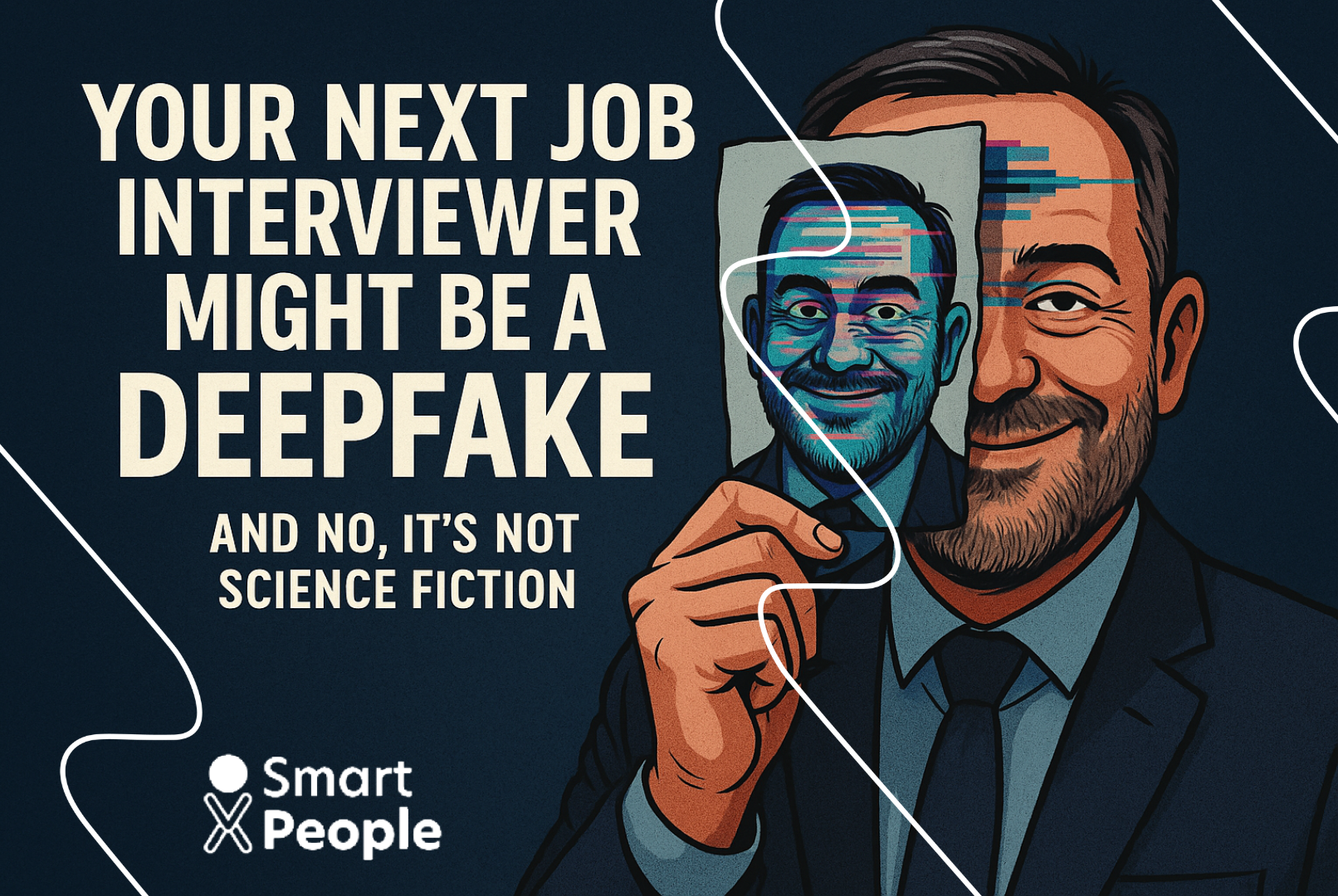
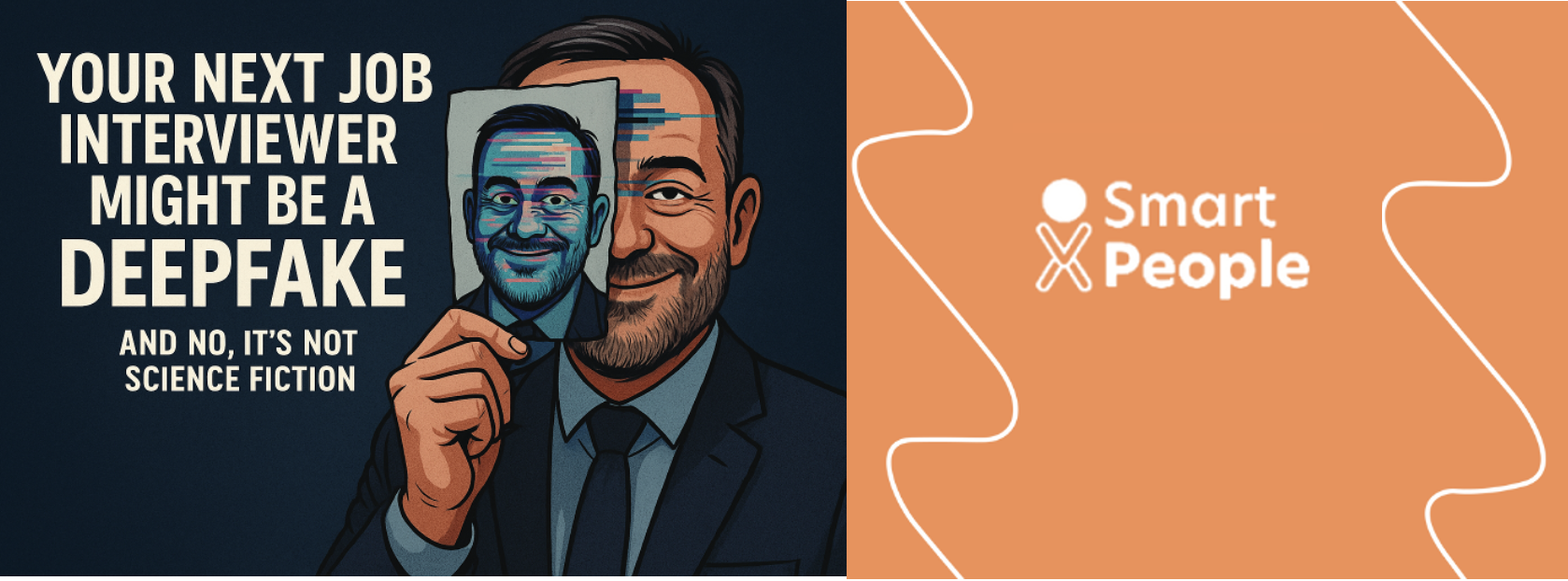
      Professional businessman in suit holding tablet displaying AI-generated deepfake face next to Smart People logo with text "Your Next Job Interviewer Might Be a Deepfake - And No, It's Not Science Fiction"

      Author:  Piotr Ławrynowicz

      "The candidate was perfect. Flawless English, solid technical answers, impressive experience. We hired him immediately. One week later, we discovered he didn't exist".

      This is the account of one of the worst recruitment nightmares of 2025.

      The Story That Sounded Like a Joke – But Turned Out to Be True

      Last month, a colleague from the cybersecurity department at one of the tech companies in Europe shared a story that initially sounded like a joke. Unfortunately, it turned out to be true:

      "We hired what seemed like the perfect remote developer. Flawless technical answers, impressive portfolio, excellent references. During his first week, we discovered something disturbing – our 'ideal candidate' had been an AI-generated persona. Real-time deepfake technology. Fabricated identity. The works."

      Welcome to 2025, where your biggest recruitment challenge isn't finding good candidates – it's proving they're real.

      The Numbers Are Terrifying

      Based on industry reports analysis:

      • Authentication failures in remote hiring increased 180% (Security Boulevard, 2024)
      • Video interview anomalies detected in 12% of screenings (Personio analysis)
      • Identity verification requests up 240% year-over-year across major platforms

      Here's the math that should terrify every CFO:

      Cost of one ghost employee (calculation):
      • Average senior developer salary: €6,500/month
      • Onboarding costs: €8,000
      • Lost recruitment time: €12,000
      • Project delays: €15,000
      Total damage: €41,500 per phantom hire

      That's not a typo. It's basic operational math.

      That's not a typo. It's not science fiction. It's happening right now.

      How We Got Here (The Perfect Storm)

      Let's be clear: this wasn't inevitable, it was predictable.

      The convergence happened fast:

      • Deepfake technology became consumer-grade (€50/month subscription)
      • Remote work normalized video-only interviews
      • AI voice cloning reached real-time capability
      • Identity verification remained stuck in 2015

      Result: The cost of creating fake candidates dropped 95% while detection methods stayed static.

      The Anatomy of a Perfect Crime

      Let me walk you through a real case from our client files (anonymized, obviously):

      Target: Senior Software Developer, €80K salary, full remote
      Method: Sophisticated multi-layered deception

      Phase 1: Profile Creation

      • AI-generated LinkedIn profile with 500+ connections
      • Synthetic work history spanning 8 years
      • GitHub account with AI-written code commits
      • Professional headshots created by deepfake generator

      Phase 2: Application Process

      • Resume perfectly tailored by ChatGPT to job requirements
      • Cover letter that hit every keyword and pain point
      • Reference letters from "former colleagues" (also AI-generated)

      Phase 3: Interview Process

      • Video interviews using real-time deepfake technology
      • Voice responses generated by advanced AI with personality modeling
      • Technical questions answered by AI with access to coding databases
      • "Connection issues" conveniently covered any glitches

      Phase 4: The Con

      • Signed contract using synthetic identity
      • First week "worked" by AI responding to emails and Slack
      • Submitted AI-generated code that passed initial review
      • Disappeared when in-person meeting was scheduled
      Total damage: €12,000 in salary, €15,000 in onboarding costs, €20,000 in project delays, immeasurable reputational risk.

      Red Flags Your HR Team Needs to Know

      Based on our analysis of confirmed deepfake cases, here are the warning signs:

      During Video Interviews:

      • Unnaturally consistent lighting on face despite head movement
      • Lip-sync delays of more than 200ms consistently
      • Facial expressions that don't match emotional content
      • Background inconsistencies between different interview rounds
      • Audio quality that's suspiciously perfect with zero ambient noise

      Behavioral Red Flags:

      • Reluctance to turn camera on immediately when asked
      • Preference for specific video platforms (some work better with deepfake tech)
      • Avoiding spontaneous questions outside prepared topics
      • Perfect answers that sound too polished for improvised responses
      • Inability to show physical documents during interview

      Technical Red Flags:

      • Metadata inconsistencies in submitted files
      • Writing style analysis showing multiple authorship patterns
      • Social media footprint that's too perfect or recently created
      • Reference contacts that only communicate via email/text

      The €2.5 Million Question: Prevention vs Detection

      Here's the CFO math that matters:

      3-Level Verification Framework:

      Level 1 (Basic Protection): €2,000/year

      • Live video verification with movement requests
      • Document authentication via blockchain
      • Multi-platform identity cross-checking

      Level 2 (Standard Protection): €8,000/year

      Everything from Level 1, plus:

      • Biometric identity verification platforms
      • AI detection software for video analysis
      • Comprehensive background screening

      Level 3 (Enterprise Protection): €15,000/year

      Everything from Level 2, plus:

      • In-person verification for final stage
      • Professional investigation services
      • Continuous authentication during probation

      ROI calculation: Preventing one false hire (€41,500) = 3-4 years of Level 2 protection costs.

      The math is brutal. You can't afford NOT to invest in verification.

      What Smart Companies Are Doing Now

      Stop debating whether this is real. Start implementing verification.

      Immediate actions (this week):

      • Institute live video verification with spontaneous movement requests
      • Require document authentication during interviews
      • Cross-check candidate identity across multiple platforms
      • Train HR teams on deepfake detection signs

      Medium-term upgrades (next quarter):

      • Deploy biometric identity verification platforms
      • Implement AI detection software for video analysis
      • Establish multi-stage interview processes with different interviewers

      Enterprise-level protection (for high-risk roles):

      • Mandate in-person verification for final candidates
      • Employ professional investigation services for senior hires
      • Implement continuous authentication during probation periods

      The Compliance Nightmare You Haven't Thought About

      Here's what legal teams are discovering: hiring non-existent employees creates massive compliance issues:

      • Tax obligations for phantom employees
      • Data protection violations if fake identities access systems
      • Insurance liability if deepfake employees cause damage
      • Regulatory reporting issues in regulated industries

      One client in financial services faced a €200,000 fine when regulators discovered they had "employed" an AI-generated persona with access to customer data for three weeks.

      The Future Is Already Here

      Don't ask: "Will deepfake recruitment become a problem?"
      Ask: "How quickly can I implement verification systems before I hire my first ghost employee?"

      Because while you're debating whether this is real, companies with proper verification are already:

      • Reducing false hire risk by 94%
      • Cutting recruitment verification time by 60%
      • Eliminating identity-related compliance issues

      The new recruitment reality:

      • Every video interview needs verification protocols
      • Every background check must include identity confirmation
      • Every hire should assume potential deception until proven otherwise

      This isn't paranoia. It's operational necessity.

      Bottom Line: Trust, But Verify Everything

      Let's be clear: AI isn't the villain here. Poor verification processes are.

      We're entering an era where the most dangerous candidates are the ones who don't exist.

      The new recruitment math:

      • Verification cost: €2,000-€15,000/year depending on risk level
      • False hire cost: €41,500 per incident
      • Break-even point: Prevent one ghost hire every 3-4 years

      Implementation priority:

      • Week 1: Basic verification protocols
      • Month 1: Staff training on detection methods
      • Quarter 1: Advanced verification systems deployment

      This isn't about being paranoid. It's about being prepared.


      DM or email: piotr.lawrynowicz@smartpeople.com.pl

        GDPR Consent

        By submitting this contact form, I consent to the processing of my personal data by Smart People for the purpose of responding to my inquiry, in accordance with the principles set out in the Privacy Policy and pursuant to Regulation (EU) 2016/679 (GDPR). Providing my data is voluntary, but necessary for this purpose. I have been informed of my rights to access, rectify, and request the cessation of processing of my data.

        11Aug

        Why AI Won’t Replace HR Outsourcing – On the Contrary, It Will Drive Demand Through the Roof

        AI powers processes, humans power results.

        Author:  Piotr Ławrynowicz

        Everyone says AI will revolutionise HR. They’re right – just not in the way you might think.

        A Brief Recap of Earth-Shattering News From the Past 20 Years:

        1. The 1980s – the first home computers arrived (Sinclair, Commodore, Atari, Amiga, and friends). Scientists warned: “Young people will get used to an unreal world and society will lose its mind.”

          Indeed, society did lose its mind – though not because of computers, but thanks to bad sitcoms.
        2. Also the 1980s – The Terminator hit the cinemas, kick-starting a fashion for Judgment Day stories – self-learning systems hell-bent on wiping out humanity. It was, in many ways, a remarkable production. Only one small detail: back then people knew about IT about as much as a dog staring at the moon.

          They actually knew more about outer space – yet to this day no one has delivered on any grand plan to colonise the Moon or Mars.
        3. The 1990s – the apocalypse was cancelled. IT moved on. We got the productivity revolution and miniaturisation. Computers became ever smaller, ever faster. The all-knowing voices predicted the next catastrophe: “People will have brain chips implanted, and everyone will be controlled by a supercomputer called THE BEAST.”

          As far as I know, I don’t have a chip in my brain – I’ve been in IT since 1996 and have yet to hear of a supercomputer running our thoughts. I did, however, once see a lift system in Warsaw allegedly based on something resembling a neural network. To this day I’m not sure what that means – perhaps someone mixed things up and, instead of installing chips into brains, they started putting them in elevators.
        4. The 21st century – after the Y2K bug and other minor episodes (not worth the belly laugh), the noise died down. Computers evolved, systems became friendlier, all doomsday scenarios were called off.

          Then about 10 years ago, Big Data showed up, followed by tools to analyse it – a short hop to AI (and yes, the first AI films had already been made).
        5. The past 7–8 years – theories about AI eliminating humans gained traction, because computing power kept growing and systems kept analysing – only now with much greater horsepower. It’s a topic that’s loud, media-friendly, anchored in pop culture. Some see AI as pure evil; others want to bet the farm on it because humans are “less efficient”.

          This article is for those who choose The Reasonable Option.

        The Great Misunderstanding of 2025

        A few days ago I was in a meeting with the CFO of one of Poland’s largest companies.
        “Piotr,” he said, “why do I need HR outsourcing when ChatGPT can already write job descriptions and recruitment algorithms screen CVs better than humans?”
        I smiled. That’s like asking: “Why do I need a mechanic if I’ve got GPS?”
        GPS will show you the way, but it won’t fix your engine when you break down in the middle of a potato field.

        The Truth About AI in HR: A Tool, Not an Employee

        AI isn’t a superhero that’s going to send your HR department into early retirement. It’s more like a super-tool that still needs someone who knows how to operate it.

        Imagine you’re handed the most advanced surgical equipment in the world. Would you immediately perform open-heart surgery? Of course not (unless we’re talking about an autopsy, in which case, good luck). You’d need a surgeon who:

        • knows when to use it,
        • understands its limitations,
        • can interpret the results,
        • takes responsibility for the decisions.

        Exactly the same applies to AI in HR.

        The New Reality: AI Creates More Work, Not Less

        1. Someone Has to “Train” the Algorithms
          Your AI recruitment system is like a puppy – at first it makes more mess than it’s worth. It needs:
          • proper data (and how many companies have clean, structured HR data?),
          • constant fine-tuning (algorithm discriminates against women? Oops.),
          • learning material,
          • result verification (did AI really find the best candidate?).
          At SmartPeople (yes, I’m quite happy to say it’s the company I work for and develop), we see this daily. Example? Here you go: a client implements AI to analyse performance reviews. After a month they call:
          “Piotr, the system shows our best employee is… the cleaning lady. What do we do??”
          Answer: you need specialists who know how to train AI.
        2. Compliance in the AI Era Is a New Level of Hell
          Remember GDPR? That was child’s play compared to what’s coming.
          The EU AI Act (already in force!) requires companies to:
          • document every algorithm used in HR,
          • ensure the “explainability” of AI decisions,
          • audit bias in recruitment systems,
          • obtain employee consent for AI monitoring.
          How many of your internal HR people know these regulations – and how many have time to keep up with them?
        3. Human-in-the-Loop Isn’t Optional, It’s Essential (!!!!!!!)
          AI can process CVs in seconds. But what about a candidate who:
          • has a five-year gap in their CV (depression? caring for a parent or child?),
          • changes industry every two years (unstable or adaptable?),
          • has an education unrelated to the position (outsider or diamond in the rough?).
          AI sees patterns. Humans see humans – and feel them. Has everyone in HR forgotten that it’s not just “Resources”, it’s first and foremost “Human”? In our projects (SmartPeople – yes, let’s say it loud), we use a hybrid approach: AI screens, humans decide. Recruitment effectiveness jumps by 40% – but you still need experienced recruiters who know when to ignore the algorithm.

        Why HR Outsourcing Will Grow Thanks to AI

        The Digital Photography Analogy

        Remember when digital cameras arrived? Everyone thought: “That’s it for photographers! Anyone can take a picture now!”
        What happened? There are more photographers than ever.
        Why? Because easy tools increased demand for professional quality. Everyone takes pictures – professionals do it well.

        The Same Thing Is Happening with HR and AI

        Before AI: companies had basic HR processes, did things “somehow”.
        After AI: companies see they can do it better, faster, with data. They want that level – but lack the competence, imagination, and perspective.

        Where Exactly HR Outsourcing Gains from AI

        1. AI Implementation & Management
          Our financial-sector client was rolling out AI for employee experience. A project planned for three months took fourteen. Why? Because no one internally knew:
          • how to prepare the data,
          • how to define success metrics,
          • how to integrate with existing systems.
          Result: they now outsource entire AI projects to us. Fourteen days to go-live, ROI guaranteed.
        2. Data Analysis & Insights
          AI generates mountains of data. Does your HR Business Partner have time to analyse 47 dashboards a day?
          Our teams deliver actionable insights, not raw numbers, e.g.:
          • “Peter has a 73% probability of leaving in Q2 – here are three retention actions.”
          • “Your recruitment process is 23% slower than the benchmark – here are the bottlenecks.”
        3. Continuous Learning & Adaptation
          AI doesn’t self-evolve. It needs people who:
          • track new regulations,
          • test new tools,
          • benchmark against the market,
          • adapt processes.
          Problem: your internal HR doesn’t have time for R&D – they’re busy with daily operations.
          Solution: you outsource to teams who live on the bleeding edge.

        ROI That CFOs Will Love

        One of our clients (manufacturing company, 800 employees) compared costs:

        Scenario A: Internal AI/HR team Monthly Cost
        Senior HR Data Scientist€5,500
        HR AI Specialist€4,000
        Compliance Officer€3,300
        Software licences€1,800
        TOTAL + recruitment, training, turnover risk €14,600
        Scenario B: Managed outsourcing with us Monthly Cost
        TOTAL + elastic capacity (scale up/down), zero recruitment hassle, guaranteed expertise level, KPI-managed outcomes, payback period €9,300

        The Future Is Already Here

        Don’t ask: “Will AI replace HR outsourcing?”
        Ask: “How quickly can I implement AI-powered HR outsourcing so my competitors don’t leave me in the dust?”

        Because while you’re still wondering whether to recruit in-house AI specialists, your competitors are already:

        • automating 67% of recruitment processes,
        • predicting employee churn with 89% accuracy,
        • cutting time-to-hire by 45%.
        And they’re doing it with outsourced teams who can start tomorrow.

        Bottom Line

        AI will not replace HR outsourcing. AI makes HR outsourcing absolutely essential.
        Why? Because AI isn’t “set and forget”. It’s “set, tune, monitor, adapt, improve” – forever.
        And who has the time and competence for that? Not your internal HR, tied up in day-to-day firefighting.
        Specialists who live and breathe AI. Who test, learn, adapt – and deliver results, not experiments.

        Want to see how AI-powered HR outsourcing could transform your company?
        14 days to first results, 7 months to payback, full KPI transparency.
        DM or email: piotr.lawrynowicz@smartpeople.com.pl

        PS: The best CFOs in Europe already get this. The only question is: will you be in that group – or in the one still “thinking about AI in HR”? (Both answers are fine, but only one will save you the time and money your company actually exists for.)

        \