
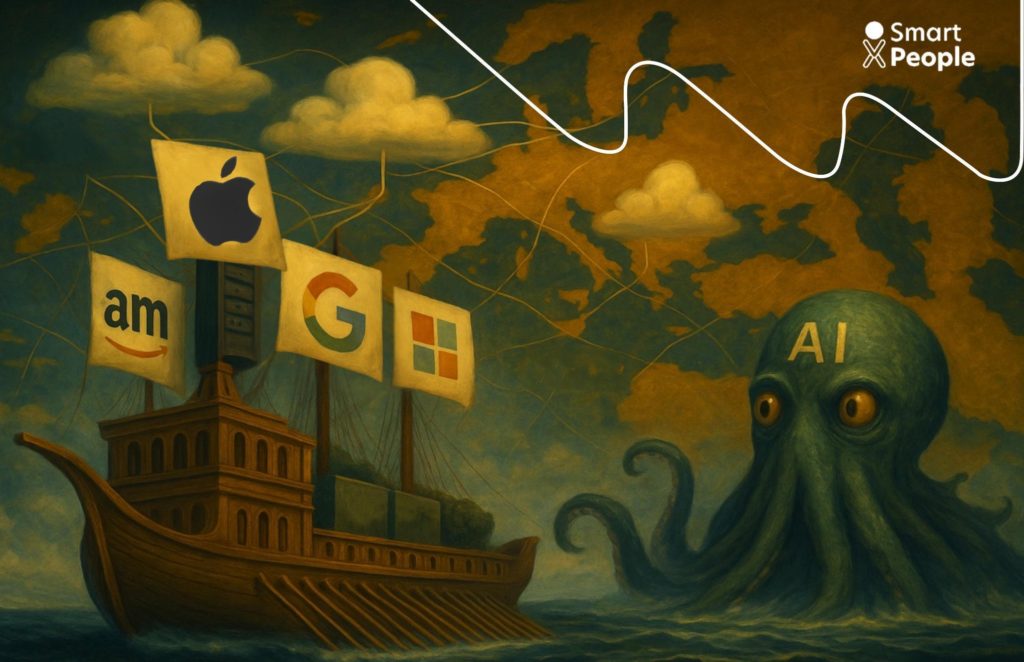
Digital Empires: How Global Corporations Became the Sovereigns of Competence
In the 16th century, whoever controlled the sea routes controlled the spice trade.
The fleets dictated the price of pepper in London and silk in Venice.
Today, ships have been replaced by servers, ports by the cloud, and East India companies by tech giants that control something far more valuable than spices — access to knowledge and competence.
Amazon, Google, Microsoft, Tencent — these are no longer companies.
They are digital empires with their own laws, infrastructure, and influence that reach far beyond national borders.
And just as merchant cities once had to negotiate with colonial fleets, companies relying on external expertise must now realise that their suppliers are no longer subcontractors — they are strategic allies in a world where skills are currency and time is a luxury no one can afford.
Digital Sovereigns and the New Rules of Power
When Amazon changes AWS policies, tens of thousands of businesses worldwide adjust overnight.
When Meta tweaks its moderation algorithms, marketers in Warsaw, San Francisco, and Mumbai rebuild campaigns by Monday.
These are not suggestions — they are decrees, operating with the force of sovereign authority.
The difference?
No one elected them. Yet their influence over business operations exceeds that of many governments.
Just like in the Age of Exploration — those who controlled the routes controlled the trade — today, those who control digital infrastructure and access to competence control the pace and direction of the game.
TaaS: Your Fleet of On-Demand Competence
In this world of digital empires, Team-as-a-Service (TaaS) is the modern equivalent of the Renaissance condottieri — mercenary formations for hire.
But instead of soldiers, you command AI engineers, SAP experts, and market strategists.
And instead of year-long contracts — a call, two days of due diligence, and your team is ready on Monday.
Real-World Example:
A global fintech plans to expand into Southeast Asia.
It needs senior IT talent, local compliance experts, SAP specialists.
Traditional hiring?
Three to six months, HR risk, onboarding costs, uncertainty.
TaaS?
A blended team from Poland, Germany, and Singapore — onboarded in two weeks.
Fully integrated with the client's systems.
Paid for results, not hours.
TaaS is your HR risk insurance and your response mechanism in an unstable world dictated by digital sovereigns.
It's not outsourcing — it's competence activation on demand.
You power up when needed, power down when done — predictable cost, zero HR risk, full control.
Not Everything That Glitters Is Gold
But just as the condottieri could switch sides mid-battle, the TaaS model comes with its pitfalls.
Not every provider is trustworthy. Not every contract is safe.
Critical Risk Factors:
Compliance & Data Security — ISO and SOC2 are not résumé decorations; they are tickets to the table.
Each jurisdiction has its own rules — what's acceptable in Singapore may fail an audit in Frankfurt.
GDPR in Europe, fragmented privacy laws in the US, evolving frameworks in China and Japan — your TaaS provider must juggle them all simultaneously.
Reputation Management — Relying too heavily on one vendor is like mooring every ship in the same harbour during a storm. Diversify, define clear SLAs, and keep exit clauses clean.
Trust & Transparency — Real-time dashboards, shared cloud workflows, visible KPIs — these are not add-ons anymore; they are the baseline for collaboration.
Companies that treat TaaS like traditional outsourcing ("delegate and forget") lose.
Those that build partnerships of trust and accountability — win.
2026: What's Next
The coming months will bring convergence — several trends reaching critical mass:
- Global Competence Without Borders — A team from Warsaw, Berlin, and Singapore operates as if sitting in one room. Geography is gone; competence remains.
- AI + Human = New Normal — Automation handles repetition. Experts focus on decisions. TaaS becomes a fusion of people and intelligent machines.
- Unprecedented Flexibility — Monthly contracts, pause options, team reshuffles in a week, success-based billing. Clients gain control like never before.
- Compliance as Entry Ticket — Certifications stop being "nice to have." They become market filters.
-
Total Integration — Top TaaS teams don't work for the client; they work within the client.
They attend all-hands, use internal tools, and report directly to management.
At SmartPeople, we call this the Embedded Team model.
The End of the Game — or the Beginning of a New Era?
Business moves faster than regulation. Governments struggle to keep pace with changes rolled out quarterly by digital sovereigns.
Organizations leveraging global TaaS must stop viewing providers as contractors.
They are strategic allies in a world where competence is currency and time is the rarest commodity.
The future of outsourcing isn't just about technology — it's about legal frameworks, operational standards, and trust models set by digital empires.
Those who understand this will gain everything:
- Access to global talent
- Flexibility in execution
- Resilience in an era of volatility
Those who don't?
They'll become vassals in the empire of digital sovereigns — without control, without influence, without an edge.
Which side will you choose?
Ready to Build Your Fleet of On-Demand Competence?
Want to see how TaaS and AI-powered teams can transform your operations?
Embedded teams ready in 14 days. Zero HR risk. Full KPI transparency.