
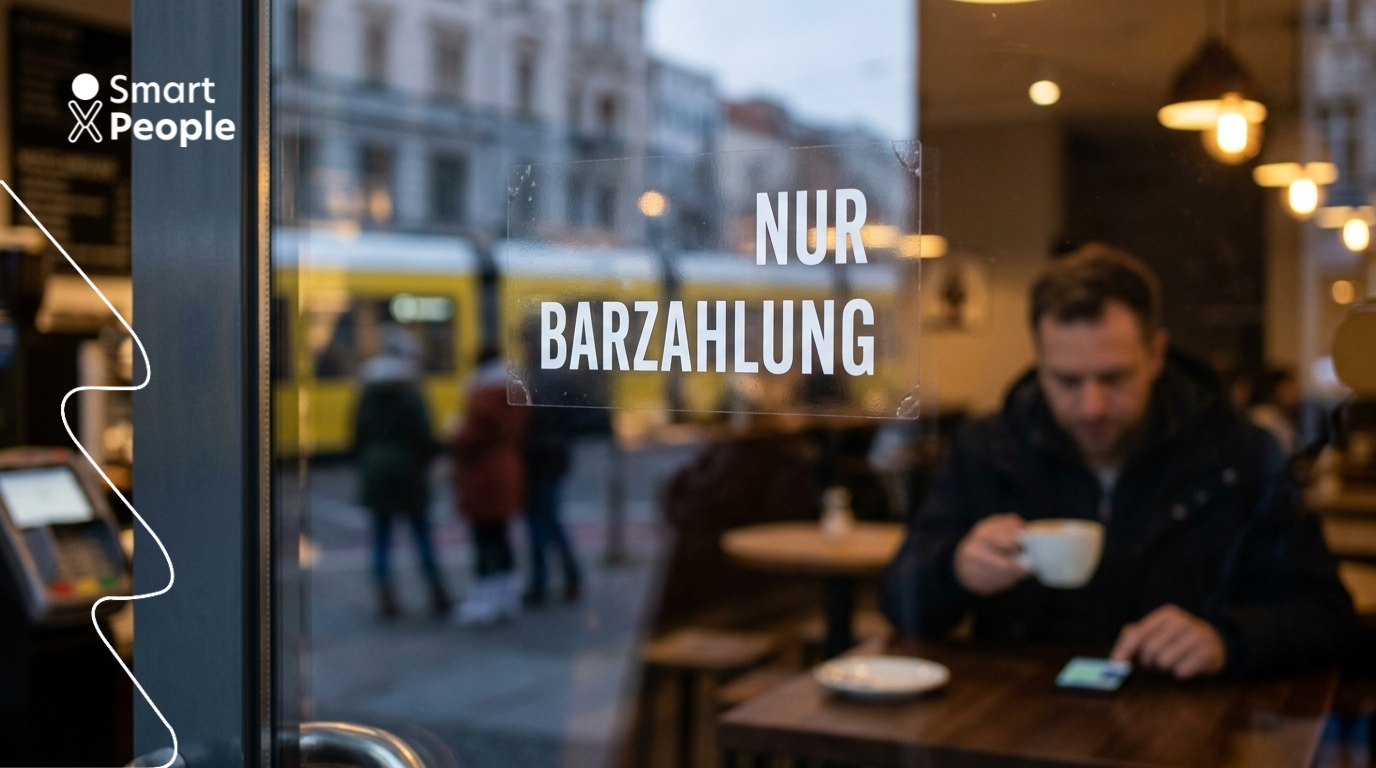
Warsaw, 9 AM. I pay for my coffee with BLIK — I don't even take out my wallet. Two days later, Berlin. A sign on the café door: "Nur Barzahlung"...
By Piotr Ławrynowicz | VP Strategic Growth, Smart People
... and suddenly I realise I'm no longer in the same world.
If you do business in Germany, that sign on the door tells you more about your clients than most market analyses. When we started expanding into the German market, one of the first things that surprised me wasn't the bureaucracy, the Betriebsrat, or the language of contracts.
As a Pole — used to BLIK, phone payments, contactless watches, and terminals literally everywhere — my first reaction was simple: How is this possible in 2026, in the fourth-largest economy in the world?
Then I started talking to clients. And very quickly I understood something important. This isn't backwardness. It's a deliberate choice. And the same mindset shows up at every negotiation table.
Numbers Worth Knowing
Cash in Germany — Deutsche Bundesbank data
Cash accounted for roughly half of all transactions in Germany in 2023 — with a clear decline compared to 2021. The direction is obvious: digital payments are growing, especially among younger Germans.
But decline doesn't mean rejection. Cash remains the most commonly used payment method in everyday transactions. "Nur Barzahlung" signs in cafés in Berlin or Munich are not a nostalgic relic — they are still normal.
And the debate about cash is very much alive. Politicians, consumer organisations and economists regularly discuss how long and in what form cash should remain in circulation.
Germany is not a country that cannot digitise. It's a country that refuses to do it blindly.
Not a Habit. A Value.
"Nur Bares ist Wahres" — only cash is real
The first time I heard this saying I treated it as a curiosity. Today I see it differently. It's shorthand for an entire way of thinking.
Datenschutz — data protection — in Germany is not a paragraph in a privacy policy. It's a value people grow up with. Cash leaves no digital trace. Nobody knows what you bought, where, or how much you spent. In a country that remembers very well where mass surveillance can lead, this isn't paranoia. It's historical memory.
There is also something that fintech presentations rarely mention: control. A banknote in your wallet is real. You see what you have. You see what you spend. No screen or app quite replaces that feedback.
And finally — a healthy distrust of systems that "work until they don't". Whenever proposals to limit cash appear in Germany, the reaction is immediate. Public, loud, and political. This isn't habit. It's a position.
You can disagree with it. But you can't ignore the logic behind it. Even if the direction of change is clear — Germans want to decide the pace themselves.
The View from the Other Side — Where We Come From
Poland — a different timeline
To be clear — I'm not saying Poland is worse or better. We're simply somewhere else on the timeline.
In Poland, the share of cashless transactions already reaches roughly two-thirds of all payments (NBP and Fundacja Polska Bezgotówkowa data).
BLIK — the Polish mobile payment system — processed 2.9 billion transactions in 2025 and has more than 20 million active users (BLIK operator data).
As a Pole, I can pay for coffee, send money to a friend, pay for parking, and order food with my phone. No wallet. No card. No cash. That's simply normal.
Which is exactly why a "Nur Barzahlung" sign on a café door in Berlin still catches many Poles off guard. But that moment of surprise is actually useful — if you turn it into understanding quickly.
Because the difference between Poland and Germany isn't about one society being more modern than the other. It's about different experiences shaping different instincts. Poland and Germany simply took different paths. The numbers show the difference. The reasons behind it are much deeper.
What Does This Have to Do with Business in the DACH Market?
Everything.
The attitude towards cash isn't just a cultural curiosity. It's a window into the value system behind German business decisions.
Four things I now expect at every DACH negotiation table
Caution. Germans rarely buy the first offer they see. They compare, analyse, and ask questions about details you might never even consider. Just as they don't blindly trust a payment app — they don't blindly trust a provider promising quick results.
Privacy and control. When the conversation turns to outsourcing consultants, access to HR systems, or employee data — the person across the table is someone for whom control over data and processes is not a preference. It's a condition.
Predictability. Cash always works. No internet, no servers, no updates required. German clients expect the same reliability from a business partner.
Long-term thinking. Germans haven't abandoned cash partly because they dislike decisions that can't easily be reversed. Choosing providers follows the same logic. They take longer to verify — but once they decide, they tend to stay.
I hear this regularly in conversations with DACH clients. Questions like: "What happens when your consultant leaves the project?" "Where does the knowledge stay?" "What guarantee of continuity do we have?"
This isn't a lack of trust. It's the same instinct that makes them keep banknotes in their wallet. They want to know they remain in control.
And if you understand why a German pays cash for coffee, you also understand why the same German may spend an extra month analysing your offer — and then stay with you for five years.
Culture shock isn't an obstacle. It's an advantage — if you understand it. Anyone doing business abroad eventually has the moment of thinking: why do they do it differently? The worst reaction is to dismiss it. The better reaction is to understand it — and adapt the way you talk, present your offer, and build relationships.
Germany doesn't move slower. Germany simply refuses to move blindly.
Cash in Germany isn't a problem to solve. It's a signal worth understanding.
Let's Talk
If you're going through your own "culture shock" in the DACH market — I'm always curious to compare notes.
It's a conversation, not a pitch.
Write to Me