
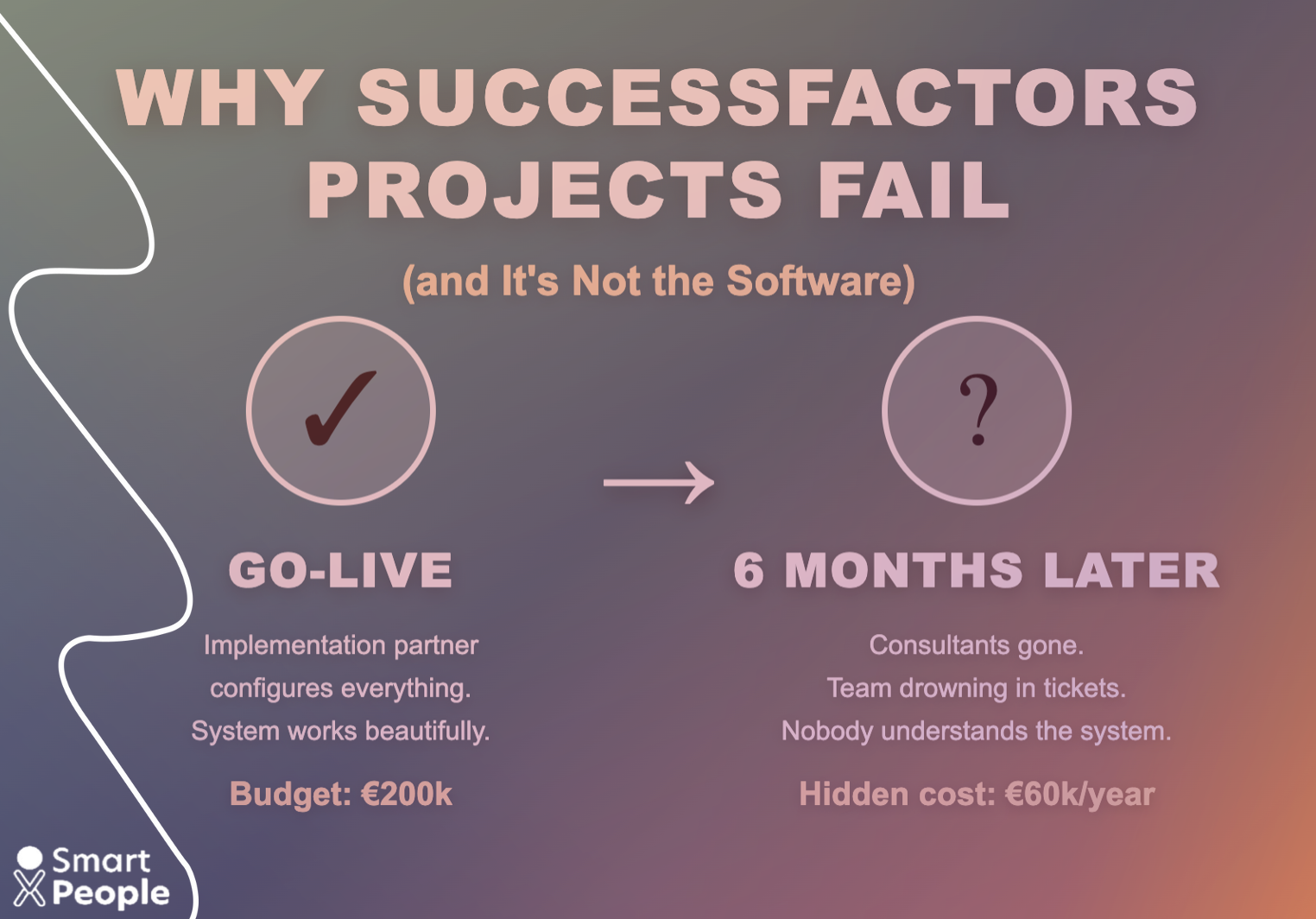
Why SuccessFactors Projects Fail (and It's Not the Software)
I've watched this pattern repeat dozens of times:
A company buys SuccessFactors. Budget approved. Licenses signed. Implementation partner hired.
Six months later: go-live.
Twelve months later: the implementation partner is long gone, the system works "sort of," and your internal team is drowning in tickets they don't know how to resolve.
Eighteen months later: SAP releases a major update. Your team panics because nobody understands what will break.
Sound familiar?
Here's the thing most companies get wrong: SuccessFactors projects don't fail because of the software. They fail because of what happens AFTER the consultants leave.
The "Black Box" Problem
Let me give you a metaphor.
Imagine you buy a high-performance car. You hire a mechanic to tune it perfectly. He does an amazing job – the car runs beautifully.
Then he leaves.
Three months later, a warning light comes on. You open the hood. You have no idea what you're looking at.
You call the mechanic. He's busy with another client. "I can come back in two weeks. My rate is €1,500 per day."
This is what happens with most SuccessFactors implementations.
The implementation partner configures everything. They make it work. But they don't transfer the knowledge. Your internal team watches from the sidelines, takes some notes, attends a few workshops.
Then go-live happens. The consultants leave. And your team is alone with a system they don't truly understand.
Three Ways This Goes Wrong
1. Your Team Doesn't Know What They Don't Know
During implementation, your internal team thinks they're learning. They attend configuration sessions. They see how the consultant sets up Employee Central, configures Role-Based Permissions, maps integrations.
But watching someone configure is not the same as understanding WHY it's configured that way.
When something breaks – and it will – your team doesn't know where to look. They don't understand the dependencies. They don't know which settings cascade to other modules.
2. The "It Worked Yesterday" Syndrome
SAP releases SuccessFactors updates twice a year. 250+ new features. Deprecations of old functionality. Changes to APIs, security protocols, data models.
If your team doesn't understand the system deeply, every release is a potential catastrophe.
I've seen companies where the internal team is afraid to apply updates because they don't know what will break. So they postpone. And postpone. Until they're so far behind that catching up becomes a massive project.
Meanwhile, they're paying for new features they can't use because they're stuck on an old release.
3. The Knowledge Evaporates
Here's the worst part: even if your team learned something during implementation, that knowledge evaporates over time.
People leave. The one person who understood how payroll integrations work takes a new job. The admin who configured Performance & Goals goes on maternity leave.
Six months later, you need to make a change. Nobody remembers how it was set up. The documentation (if it exists) is incomplete.
Why This Keeps Happening
Most implementation partners are incentivized to deliver the project, not sustainable capability.
Their KPIs are:
- Go-live on time? ✅
- Within budget? ✅
- System functioning? ✅
What's NOT in their KPIs:
- Can the client manage this without us? ❌
- Does the internal team understand the architecture? ❌
- Will they be ready for the next release? ❌
I'm not saying implementation partners are doing this maliciously. It's just the business model. They move from project to project. Your team gets six months of exposure, not six months of mastery.
What Actually Works: Knowledge Transfer as Strategy
After years in B2B sales and HR tech, I've learned this: The best implementations are the ones where the client knows what they're doing.
Not because they're tech geniuses. Because someone invested in making sure they actually learned.
Here's what this looks like in practice:
Before Implementation: Targeted Training
Don't send your team into implementation blind. Give them structured training BEFORE the project starts.
Not generic "Introduction to SuccessFactors" webinars. Targeted, hands-on training in the modules you're actually implementing:
- Employee Central configuration
- Integration fundamentals
- Role-Based Permissions architecture
- Whatever your project needs
When implementation starts, your team isn't just watching. They're active participants who understand what's happening.
During Implementation: Embedded Learning
The best model I've seen: hybrid squads.
Your internal team works alongside experienced consultants. Not as observers – as co-implementers.
The consultant configures Employee Central? Your admin does it WITH them, not just watches.
The consultant maps integrations? Your IT person is hands-on, learning the logic, not just taking screenshots.
This is slower than having consultants do everything. But the ROI is massive because your team is building real capability, not just checking boxes.
After Go-Live: Structured Handoff
Go-live should not be "consultants leave, good luck."
It should include:
- Documented architecture (not just "what" but "why")
- Runbooks for common issues
- Clear escalation paths
- Post-go-live support period where your team handles issues with consultant backup
Think of it as training wheels, not abandonment.
The ROI Math Nobody Talks About
Let's run the numbers on a typical medium enterprise project (500–2,000 employees, standard modules: Employee Central, Payroll, Performance).
Scenario A: Standard Implementation
- Implementation cost: €200k
- Internal team: minimal training
- Post-go-live: consultant calls at €1,500/day
- Average: 40 days/year = €60k annual "hidden cost"
- Over 3 years: €180k in reactive consultant fees
Scenario B: Knowledge-Transfer Implementation
- Implementation cost: €220k (includes embedded training)
- Internal team: deeply trained, confident
- Post-go-live: 80% of issues handled internally
- Consultant needs: ~10 days/year = €15k
- Over 3 years: €45k in consultant fees
Savings over 3 years: €135k
Note: These numbers are based on typical projects for companies with 500–2,000 employees using standard modules. For large, multi-country implementations, numbers may be higher; for smaller projects, lower.
And that's not counting:
- Faster issue resolution (internal team responds immediately, not "wait for consultant availability")
- Confidence to adopt new releases (your team understands the system)
- Ability to optimize over time (you're not stuck with "how the consultant did it")
What I've Learned Over the Years
The companies that get the most value from SuccessFactors aren't the ones who hired the fanciest implementation partner.
They're the ones who treated implementation as a capability-building exercise, not just a technology deployment.
They invested in:
- Training their people BEFORE the project
- Embedding learning DURING the project
- Structured handoff AFTER go-live
And yes – sometimes they augmented with external consultants when they needed specific expertise. But those consultants worked alongside the internal team, transferring knowledge, not creating dependency.
If you're planning a SuccessFactors project – or struggling with one you've already launched – ask yourself this:
"If my implementation partner disappeared tomorrow, could my team keep this system running?"
If the answer is "probably not" – you don't have a SuccessFactors system.
You have an expensive dependency.
Need a Different Approach?
At SmartPeople, we don't just deliver projects. We build capability.
Our model combines:
- Targeted SuccessFactors training for your team (hands-on, module-specific)
- Project squads of certified consultants who work WITH your team, not instead of them
- Knowledge transfer as a deliverable, not an afterthought
Typical payback: 7 months for companies that engage their internal team in knowledge transfer from day one. ROI can be faster (4–6 months) for large organizations with high ongoing support costs, or longer (12–18 months) for companies with low external support spending.
Because you're not just buying a working system – you're building a team that can evolve it.
Piotr Ławrynowicz