
SuccessFactors in 2026: Why AI Won't Replace a Team That Understands Migrations (and What You Need to Check Before It's Too Late)
In 2026, hundreds of companies will wake up to a message: "Your integrations have stopped working. System unresponsive."
This won't be a cyberattack. It will be the result of deprecations – the phasing out of older features and protocols – that SAP has been announcing in release notes for many months now.
- "AI will do it for you."
- "It'll be easier."
- "Just click."
And yes – SAP SuccessFactors is evolving rapidly. Recent releases brought hundreds of new features, including powerful AI-powered capabilities: Performance & Goals Agent, Career Development Agent, People Intelligence Agent, HR Service Agent.
Sounds impressive. But there's a catch.
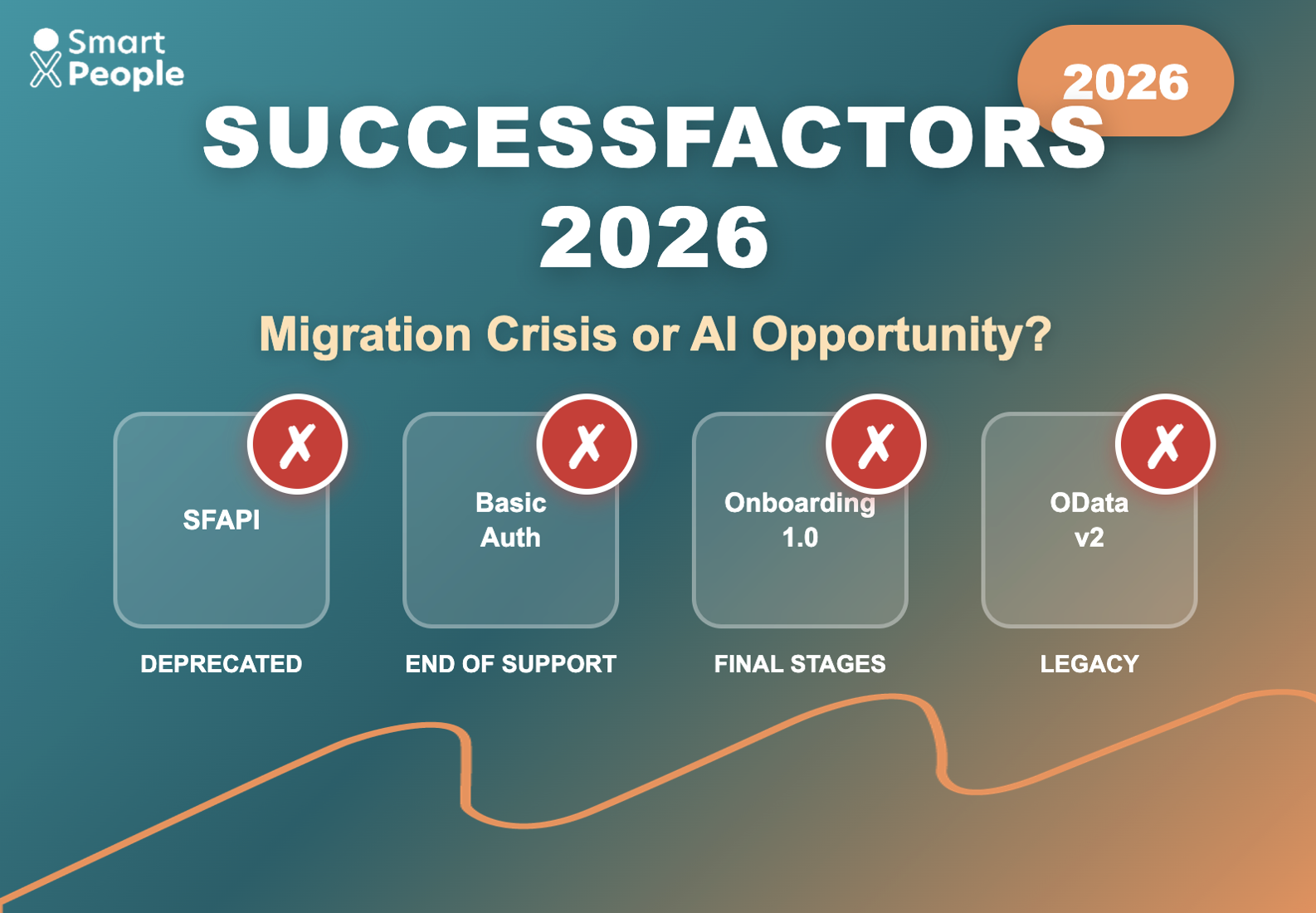
Alongside introducing new capabilities, SAP is systematically deprecating legacy infrastructure. Onboarding 1.0 is in final deprecation stages. Basic Authentication is on a clear path to end-of-support. SFAPI and older integration patterns are being phased out in favor of newer OData-based standards.
What does this mean in practice?
Companies must simultaneously:
- Migrate away from legacy solutions (requiring deep SuccessFactors knowledge)
- Configure new AI capabilities (requiring cross-platform expertise: SF + BTP + Cloud Identity Services)
- Prepare job architecture and skills governance before enabling Talent Intelligence Hub
And they must do this while – as industry research shows – a majority of organizations admit their current skill tracking can't keep up with how fast work is changing.
In other words: most companies lack both the people and the processes to handle this.
And time is running out.
Technical Depth: What Exactly Must You Change Before the End of 2026?
For SuccessFactors to stay stable and ready for new AI features, technical teams must focus on four critical areas. Ignore them, and upcoming SAP releases will feel like problems, not progress.
1. API Migration: From SFAPI to Modern OData Standards
This is the silent killer of many integrations.
SAP is retiring older communication methods, meaning some "bridges" connecting SuccessFactors with other systems (payroll, ERP, analytics) will become unsupported.
What's happening:
- SFAPI (SuccessFactors API): Is in deprecation. Integrations built on SFAPI, often used in older payroll or reporting connections, need to be redesigned to supported APIs.
- OData v2 → newer standards: OData v2 still works today, but SAP is steering customers toward newer, more efficient patterns (including OData v4) for large-scale data operations.
Why this matters:
Once SAP ends support for these legacy interfaces, there's no guarantee your integrations will survive the next upgrade. From a business perspective: data stops synchronizing when you least expect it.
- Which integrations still rely on SFAPI or old OData patterns?
- Are external systems (payroll, ERP, middleware) ready to consume newer APIs?
- Who on your team can actually redesign and test those integrations?
If the answer to the last question is "no one" – you have a problem.
2. Security: Moving to OAuth 2.0 and Certificate-Based Authentication
For years, many companies used technical users and simple login/password authentication in integrations. Convenient – but risky.
SAP has been warning: Basic Authentication is being retired and will reach end-of-support in the coming years, with timelines depending on scenario and tenant type.
What this means:
Every external application connecting to SuccessFactors will need to use modern mechanisms:
- X.509 certificate-based authentication
- OAuth 2.0 clients registered via SAP Cloud Identity Services
- Which integrations still use Basic Auth?
- Does your IT team know how to configure OAuth 2.0 for SuccessFactors?
- Do you have processes for managing and rotating X.509 certificates?
If not – this isn't a "nice to have" project. It's basic hygiene.
3. Identity: SAP Cloud Identity Services (IAS/IPS) as the New Backbone
IAS (Identity Authentication Service) and IPS (Identity Provisioning Service) are becoming the central access point for identity and access in SAP's cloud ecosystem – including SuccessFactors.
What's changing:
SAP is moving away from the model where SuccessFactors handled identity in isolation. The target architecture assumes identity is centralized in the cloud via SAP Cloud Identity Services.
Why this matters:
- Joule and AI capabilities rely on correctly resolved user identity and permissions, which IAS provides
- New SF features are designed with IAS/IPS as the default identity layer
- Integrations with Microsoft 365, Teams and other tools are simpler and safer with a consistent identity model
- Old, flat integrations directly to on-premises Active Directory are increasingly a limitation
- Do you have IAS/IPS in your SF landscape – and is it actually being used?
- Are onboarding/offboarding processes synchronized with identity provisioning?
- Who owns cloud identity strategy in your organization?
If IAS/IPS is still "on the roadmap," it should move high on your priority list – before enabling new AI features.
4. Talent Intelligence Hub: The AI Foundation Most Companies Lack
This is the biggest data model shift in years. Without it, most promises of "AI in HR" remain marketing slides.
Talent Intelligence Hub is a unified capability and skills layer connecting:
- Job profiles
- Skill libraries
- Career paths
- Performance and goals
- Recruiting and internal mobility
The problem:
In many organizations, Employee Central data is messy. Job Profile Builder (JPB) has never been consistently used or mapped to a clean skills model. Skill libraries are full of duplicates ("Java Developer" vs "Java Engineer"), vague descriptions, missing proficiency levels.
AI can't work miracles on this.
Joule, Performance Agent, Career Development Agent – all need clean, consistent data to generate meaningful recommendations. If your skills data is chaotic, AI will simply scale that chaos.
- Has your existing JPB content been analyzed and aligned with a TIH-style model?
- How many duplicates and inconsistencies exist in skill libraries?
- Do you have clear governance: who approves new skills, naming, levels?
If the answer is "we don't really know" – start with a data audit, not with flipping the AI switch.
The Real Problem: AI Requires MORE Expertise, Not Less
For years, companies have heard:
- "AI will do it for you."
- "It'll be easier."
- "Just click."
Reality looks different.
AI in SuccessFactors requires MORE technical and operational expertise than ever before.
Joule won't fix:
- ❌ Misconfigured RBP (Role-Based Permissions)
- ❌ Poorly designed job profiles
- ❌ Duplicates in skill libraries
- ❌ Integrations built on Basic Auth and SFAPI
- ❌ Missing IAS/IPS
- ❌ Chaotic data architecture
What's more – modern SuccessFactors is no longer "just an HR system." It's an ecosystem demanding knowledge across:
- SAP SuccessFactors (application and configuration)
- SAP Business Technology Platform (BTP)
- SAP Cloud Identity Services (IAS/IPS)
- Integration Suite and modern APIs (OData, events)
If your team only knows how to "click through screens in SuccessFactors," they're not ready for 2026.
Summary: How to Start Preparing?
Preparing for upcoming changes isn't a "last-minute before deadline" project. It requires close collaboration between HR, IT and data architecture experts.
- Integration audit – identify where you still use Basic Auth, SFAPI and legacy patterns
- Data architecture review – clean up Employee Central and profiles with Talent Intelligence Hub in mind
- Team upskilling – ensure administrators understand OData, OAuth 2.0, IAS/IPS and new AI features
- Competency governance – define ownership for skills libraries and maintain a single, consistent model
Need support with the technical side? At Smart People, we work with certified SuccessFactors consultants who've guided companies through complex SF migrations and AI readiness assessments. If your internal team needs external expertise – we're here.
2026 is Not "Just Another Release"
It's a strategic moment where SAP's roadmap effectively divides companies into two groups:
- Those who invested in teams that understand modern SF architecture and are ready for AI
- Those who will pay premium rates next year for firefighting in production
Which group do you want to belong to?