
Picture this: Team A spends every Monday morning 3 hours manually creating weekly status reports. Team B has the same reports generated automatically within minutes using data from project management tools. While Company X manually tracks competitor pricing across 50 websites, Company Y has an AI system that automatically monitors these sites and sends alerts when prices change. This isn't science fiction — it's happening right now in the most advanced companies.
Manual Work vs. AI-First: The Difference in Approach
Many teams are stuck in what we call "AI tourism" — they use generative tools occasionally, but their core processes remain largely manual. AI-first teams have fundamentally redesigned how work gets done, prioritizing automation from the start.
Typical Day Comparison
Traditional Team: 3+ hours on manual email sorting, meeting agendas, status updates, and proposal writing
AI-First Team: AI handles routine tasks automatically, team focuses on strategic work from 9:30 AM
The True Cost of Staying Manual
Time savings from AI isn't just the sum of saved minutes. The real cost is opportunity cost. While manual teams drown in administrative work, AI-first teams can dedicate time to building new products, acquiring customers, and solving complex challenges.
| Task | Manual Approach | AI-First Approach | Weekly Savings |
|---|---|---|---|
| Email management | 5 hours sorting/responding | 30 minutes reviewing AI summaries | 4.5 hours |
| Meeting notes & follow-ups | 4 hours writing summaries | AI transcribes and creates action items | 3.5 hours |
| Report creation | 6 hours gathering data/formatting | AI pulls data and formats automatically | 5.5 hours |
| Content creation | 8 hours writing/editing | 2 hours reviewing AI drafts | 6 hours |
| Data analysis | 10 hours manual spreadsheet work | AI analyzes and visualizes data | 9 hours |
Note: The above data is estimated and shows maximum potential achievable with full automation of routine tasks. Actual savings may vary.
How AI-First Teams Actually Work: Concrete Examples
Automated Project Progress Summaries
Manual approach: Weekly status meetings, manual progress tracking, constant Slack check-ins.
AI-first approach: Tools like Notion AI, ClickUp AI, or Asana AI automatically generate team progress summaries based on actual task changes.
Fast Proposal Preparation with AI Support
Manual approach: Creating each proposal from scratch, manual template customization, hours of formatting.
AI-first approach: AI generates initial versions based on key parameters from the sales team. Employees personalize content and approve sending.
Market Research Automation
Manual approach: Days spent manually gathering data, analyzing competition, creating reports.
AI-first approach: Using Perplexity for quick public data gathering, GPT for generating syntheses, and Claude for analyzing larger datasets.
Data and Research: What the Numbers Say
McKinsey's "The State of AI in 2024" report clearly indicates that companies implementing AI at the daily workflow level gain productivity advantages. However, only 23% of companies globally use AI in their most strategic processes. Gartner predicts that by 2026, 80% of organizations will use tools automating typical office activities.
In Poland, while comprehensive public research from 2024 is limited, observed market trends indicate the most common AI use cases are:
- Automated reporting
- Email follow-up
- Document processing
- Online customer support
Small Company vs. Large Organization: Who Benefits More?
Small Company/Startup
Advantages: Fast implementation, immediate impact, easier adaptation
Challenges: Limited budget, lack of dedicated IT team
Large Company/Corporation
Advantages: Larger budget, custom development possibilities
Challenges: Legacy system integration, resistance to change
Implementation: From Pilot to Production
Week 1-2: Diagnosis and Foundation
Process audit, identifying most time-consuming tasks, implementing basic AI tools (e.g., ChatGPT Plus, Notion AI).
Week 3-4: Quick Wins
Automating email summaries, meeting notes, simple reports and content.
Week 5-8: Advanced Automation
Integrations using tools like Zapier, AI-supported data analysis, customer research automation.
Week 9-12: Full Integration
Implementing more complex, multi-stage workflows requiring less supervision.
Frequently Asked Questions (FAQ)
Does AI-first work in small companies?
Yes. Often the effects are faster because decisions are made more efficiently, and every saved hour has greater significance in a small team.
What about jobs?
In practice, AI frees up team time for more creative tasks and developing new services, and doesn't necessarily lead to job reductions, especially in dynamic companies.
What if we don't have an IT team?
Most modern tools (like Notion AI, ClickUp, Jasper, Perplexity, Gemini, Claude, GPT) are designed to be implemented without specialized technical knowledge.
Which processes should be automated first?
Repetitive, routine activities: reports, status updates, initial summaries, follow-ups, competitor research.
What are the main implementation mistakes?
Limiting to "AI tourism" instead of building systematic workflows, trying to automate everything at once, lack of proper team training, ignoring input data quality.
The Future is AI-First, Not AI-Optional
Companies that treat AI as an optional add-on risk being left behind. The gap between manual and AI-first teams is growing, and their productivity may differ significantly.
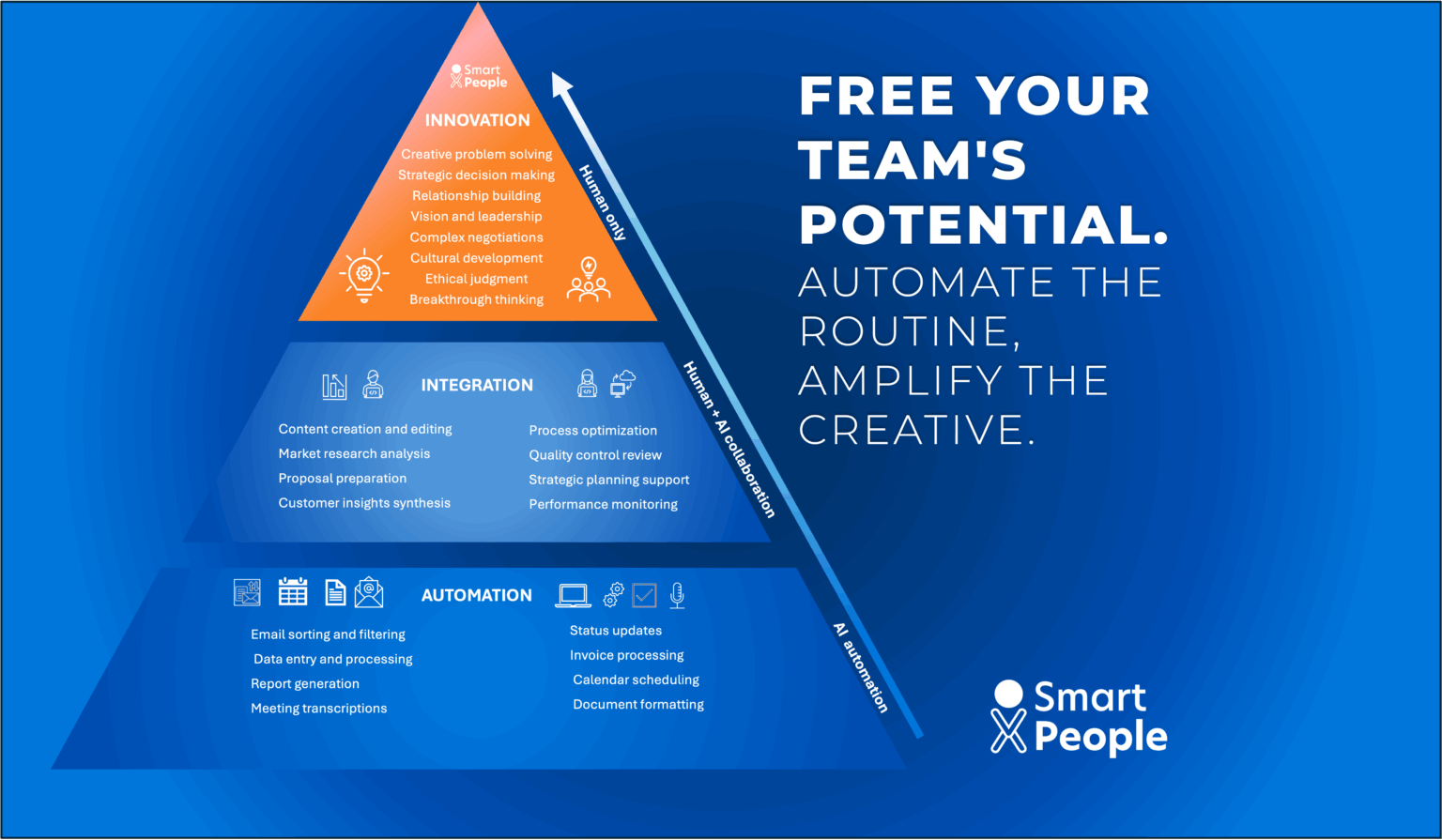
Automation Boundaries and Human Role
AI makes our lives easier, but we still need human reflection, empathy, courage, and situational judgment. The best teams don't give AI full decision-making power — they set clear boundaries: what we leave to humans and what AI can handle.
The New Role of Leadership
The new role of leadership involves mentoring, team development, and creating a culture of trust and continuous learning. Leaders in the AI era no longer manage "task lists" — their main goal is maximizing human potential that is unleashed through automation.
Ready for Transformation?
AI-first transformation isn't just about tools — it's a mindset change. The question is: will your team lead this change or fall behind?